A Frontmezzjunkies Interview: Janelle Cooper and the Woman Behind the Fairy Tale
By Ross
Cinderella is one of those stories we think we know before the curtain even rises. The wicked stepmother, the stepsiblings, the girl with the glass slipper, the fairy godmother, the prince, and eventually the promise of “happily ever after.” But what happens when the story refuses to play by those rules? Branden Jacobs-Jenkins’ A New Work in Progress, receiving its world premiere in a developmental workshop at the Shaw Festival, takes the familiar Cinderella story and turns its attention toward the lives these characters might have had before the fairy tale, inside it, and maybe after it. It is a darkly comic exploration of where these people come from, where they might be going, and what happens when the neat boundaries between good and evil begin to blur.
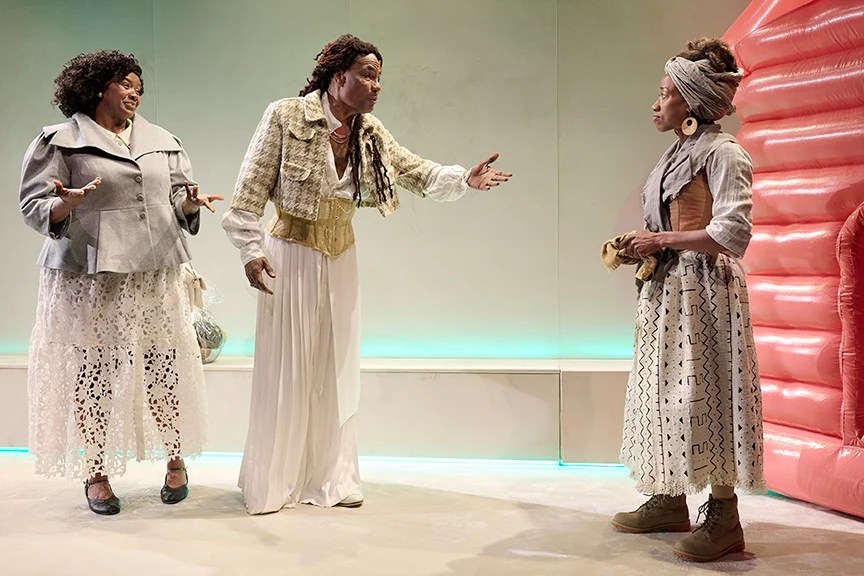
At the centre of that world is Janelle Cooper (Grand Theatre’s The Sound of Music), who plays the New Wife, a woman who could easily be reduced to the familiar role of the ‘evil stepmother’ but who Cooper approaches with love, curiosity, and an understanding of the life that came before the fairy tale. The New Wife’s words to Ashley can be brutally honest, deeply uncomfortable, and even cruel, yet Cooper sees a woman trying to prepare children for a world she knows can be unforgiving. As the production continues its workshop run at the Court House Theatre, I spoke with Janelle Cooper about finding the woman inside the archetype, the complicated ways adults teach children how to survive, and what it means to help discover a new work while it is still finding its way.
FrontMezzJunkies: A New Work in Progress is being presented while the work itself is still developing. What is it like as an actor to build a character while the play around you is still changing? What have you discovered about the New Wife through that process that you might not have found in a more finished script?
Janelle Cooper: When we embarked on this work, Branden created containers that sparked vibrant dialogue amongst the ensemble. It was through this exchange that I started to question the judgement traditionally placed on Step Mother. Who was she before she was a Mom? What might have happened in her life to shape the way she raised her children, and subsequently Cinderella/Ashley? I made the decision early on not to condemn her. I chose to approach her with love instead. It’s necessary that we see her beyond the archetype. She is Mother, she is Woman, she is Survivor. I rooted myself in her resistance, not her fight. Her methods are questionable, to say the least. But I believe the intention is earnest, and comes from a place of love.
FMJ: Cinderella is such a deeply familiar story, and audiences arrive with a very clear idea of who the stepmother and stepsiblings are supposed to be. What did you discover about the New Wife that you could not have found simply by thinking of her as the “evil stepmother”?
JC: We accessed the world from various doorways. Because Branden wrote while we built, there was ample space for discussion and discovery. He remained open to our impressions and expressions of who these individuals were becoming, imposing conditions for us to explore, experience, and respond. I love devised work for that very reason. Nothing is prescribed. It’s an organic mapping of the world. My job is to remain open to it and explore each door. Behind one of them, I saw her as a child. A reflection of the children she kept safe and alive. I asked who, if anyone, did that for her?
FMJ: The relationships between Ashley, the New Wife, the Father, and the other children complicate the traditional idea of the “evil stepfamily.” What does the New Wife believe children need to learn in order to survive, and how does the world she came from shape those lessons?
JC: I think it’s sociocultural at its core. Step Mother and kids come from the city. It’s overpopulated and polluted. She’s a single mother. They struggle. The wisdom she imparts onto her children keeps them safe. It keeps them alive. Ashley’s experience is very different. Their time with Godmother is sheltered and charmed. How can they possibly survive in the “real” world? Step Mother tries to build the callus to ensure that survival.
FMJ: There is a fascinating sense that children inherit emotional behaviours from the adults around them without necessarily understanding where those behaviours came from. The New Wife has a history as well, and the lessons she gives these children seem connected to the lessons she learned herself. How did that history affect the way you approached her relationship with Ashley and her own children?
JC: She was a child once, too. If survival is at the crux of her lived experience, and she’s made it this far, I know that she is also tactful and strategic. The proposition from Father presents an opportunity to overhaul her ecosystem. If she can change her current circumstances, she can reshape the future for her children. Ashley included. She is preparing them the way she was prepared. And sometimes that isn’t pretty. But it’s what she knows. I think it’s all she knows.
FMJ: Some of the New Wife’s words to Ashley can feel brutally honest and deeply harsh at the same time. Does she understand that she is hurting Ashley, or does she genuinely believe she is teaching them something they need to know about the world? What does she believe she is preparing these children for?
JC: I think she knows it hurts. I also think in order to prepare them for the harsh realities they will inevitably face, that it has to. Love hurts! She’s also living proof of what that level of grit can yield. She met a wealthy man who transplanted her and her children to a seemingly safer and cleaner community. She doesn’t have to work, and they can “… breathe clean air for once.” She is proof that it works. At least she thinks she is, because they will never have to suffer the way she did.
FMJ: The New Wife clearly believes that what she is doing is necessary, even when that necessity causes harm. We are used to Cinderella giving us a very clear division between good and evil. After spending time inside this family, what do you hope audiences begin to question about the stories we tell ourselves about good people, bad people, and the possibility that people who cause harm may also believe they are doing the right thing?
JC: I think it’s easy to judge from the outside in, but what you see is never the full story. Our version of this fairytale reminds us of that. I think it forces one to hold the mirror and question, “What would I do? What could I do?” She is desperate and goes to extreme lengths, which isn’t pretty but speaks to the beauty of sacrifice. So I think it reinforces what we already know: that goodness is subjective.
FMJ: After living with the New Wife and this family through the process of creating the show, has your understanding of the Cinderella story itself changed? Is there anything about “happily ever after” that you look at differently now?
JC: My impression of the story has certainly shifted, but it hasn’t reframed what “happily ever after” looks like for me. That idea evolves as I evolve, as the things I need to survive evolve. Because it’s all relative, at the end of the day.