The Opera Review: Verdi’s tragedy pulls me from extravagant parties into a world of love, sacrifice, and heartbreak.
By Ross
This year I made a plan, or maybe you could call it a challenge, to take in opera in a way I’ve never really done before. To give myself permission to really see it, hear it, and perhaps most importantly, feel it. So when the curtain slowly rose on the Canadian Opera Company’s La Traviata, I found myself completely drawn in by a large baroque mirror floating in a pool of light as a woman in white was dressed in finery by her maid. The scene was so gloriously beautiful that I couldn’t stop myself from thinking about Julia Roberts.
Weird, I know, but Giuseppe Verdi’s 1853 masterwork is the opera at the centre of one of the most famous scenes in “Pretty Woman“, where Vivian sits in a red gown and diamond necklace, hears La Traviata for the first time and bursts into tears. I could almost hear Richard Gere’s Edward leaning over my shoulder to ask me whether I am the sort of person who appreciates opera intellectually or feels it in my soul. As the music begins to draw me into this story of Violetta Valéry, I realize I may be somewhere closer to the latter, already being pulled in emotionally. “La traviata” literally translates as “The Fallen Woman,” something I didn’t understand when I walked into the opera. And suddenly, that title makes the story of Violetta feel even more loaded.
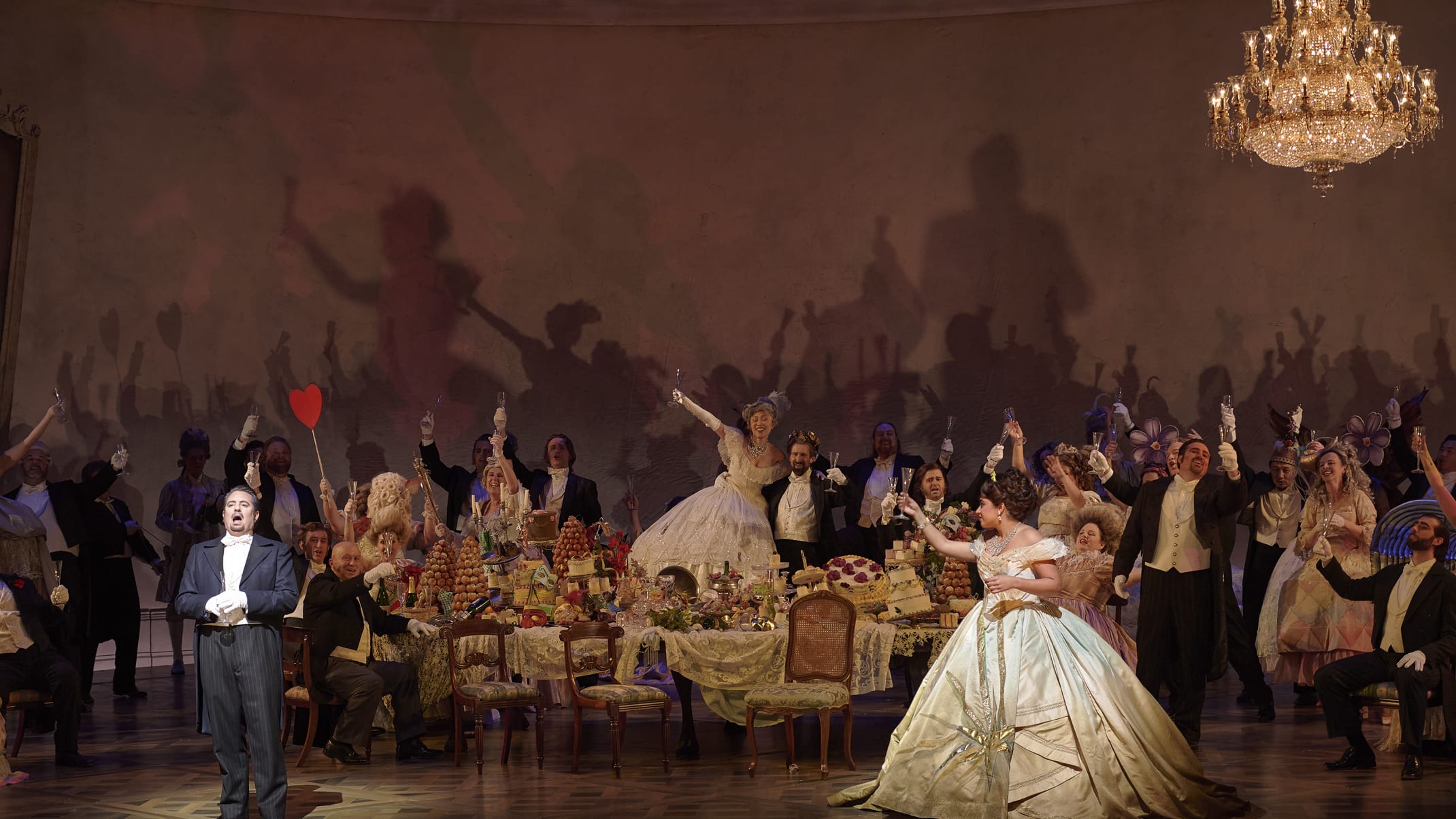
Directed by Arin Arbus, with revival direction by Mo Zhou, the production opens with such dreamlike precision that the music and image seem to arrive together, creating my first real encounter with La Traviata beyond the “Pretty Woman” snippet I thought I knew. That elegantly simple opening soon gives way to a sumptuous explosion of theatrical excess. The circular gaiety of the party arrives dancing and celebrating itself around a banquet table so overloaded with Marie-Antoinette-like cakes that it seems ready to collapse beneath its own decadence. Riccardo Hernandez’s set and Cait O’Connor’s costumes magnificently create a world of extravagant beauty, while animal puppets, heavenly symbols, and gigantic shadows transform the space into something like a Chinese revolving lantern, with moving silhouettes turning celebration into something slightly uncanny. Marcus Doshi’s lighting becomes crucial to that transformation, casting the festive world in glorious illumination before allowing the shadows to grow deeper as Violetta’s circumstances darken.
When Violetta declares that pleasure is the best remedy for what ails her, Kathryn Lewek throws herself into that pleasure with astonishing vocal and physical freedom. Her opening aria is rapturous, playful, and dynamically alive, even as another voice of love rises outside in the streets. The contradiction is deliciously theatrical, as the ideal begins to draw her toward a feeling she insists she cannot bear. Violetta is trying with all her might to sing herself into a life devoted to pleasure while the opera is already whisking her away into another future and the arms of Alfredo.
That future arrives soon after. With Alfredo, whose voice brings a glorious warmth and tenderness to their growing love, Violetta is restored. But that bliss is only temporary, as it shifts dramatically when Alfredo’s father, Giorgio Germont, arrives. Chinese tenor Long Long is initially tentative as Alfredo, taking some time to find his footing in the first act. But as his love for Violetta deepens, so does the warmth and confidence in his voice, and by the second act he has grown into something wonderful.
As Alfredo’s father, Giorgio Germont, Russell Braun is exquisite, arriving with a clear purpose. He allows the tenderness of his encounter with Violetta to alter the emotional temperature of the scene, and he handles that change beautifully. He asks her to sacrifice her happiness for the sake of Alfredo’s family, and Braun navigates that request with extraordinary complexity, allowing Germont’s stance to shift as he recognizes the woman in front of him. Lewek meets him with equal emotional force. Violetta understands exactly what she is being asked to surrender, and when she complies, against her own desire and love, the sacrifice lands with devastating weight. Verdi’s music gives that decision a pulse of its own, allowing us to hear the terrible cost of doing something for love that will destroy the very happiness love has created.
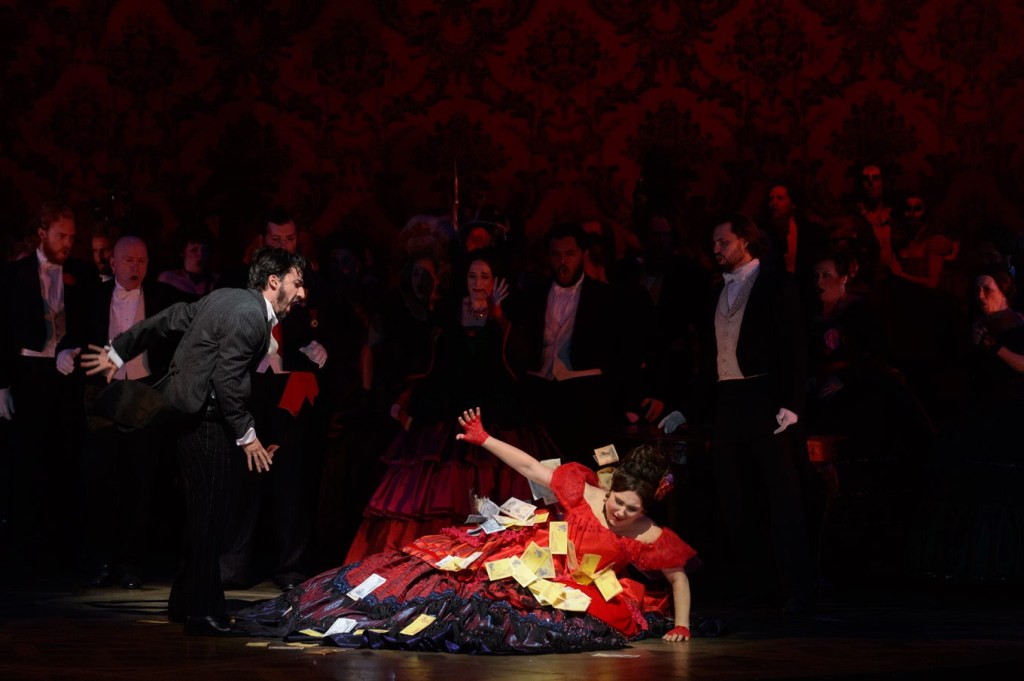
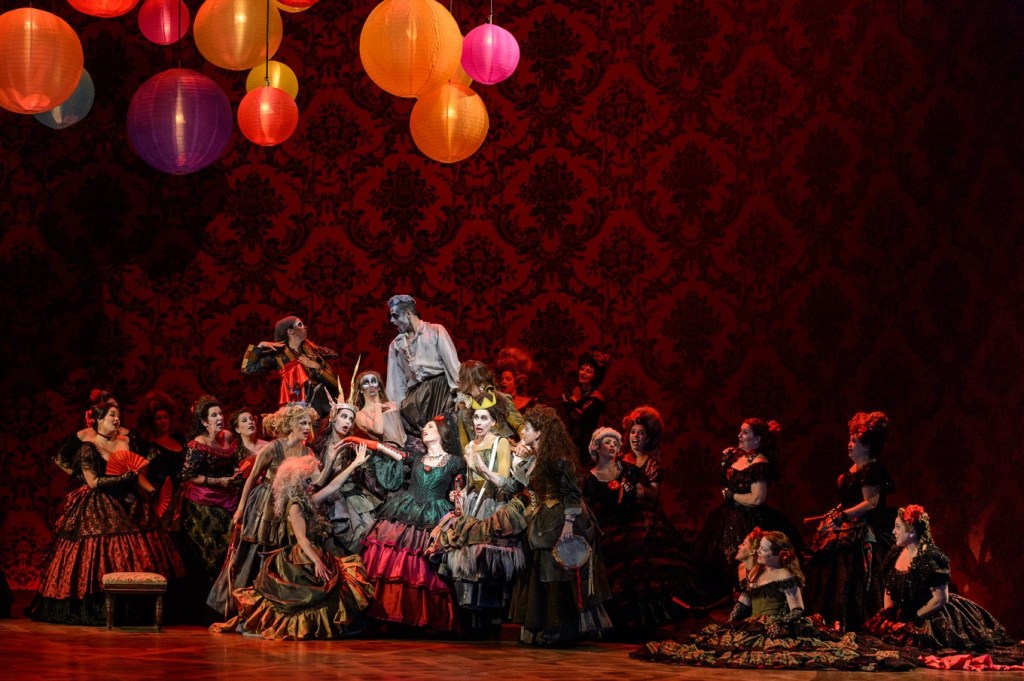
The latter party returns us to extravagance, but the atmosphere has changed completely. Deep red fills the space, dark vibrant globes of light echo the dresses and mood, and the matador dance becomes a deliciously decadent eruption of gender-fluid costumes and magnificent bull puppets. The sequence has the energy of seduction and danger colliding at once, with Austin McCormick’s aggressive choreography and sexual playfulness surrounding a story already moving toward cruelty. Then Alfredo arrives, bitterly declaring himself unlucky in love but lucky at cards, and the gambling table becomes the stage for another kind of humiliation, but not his. When Violetta enters on the arm of Baron Douphol, jealousy takes control. Alfredo repeatedly wins money from the Baron, and it seems the more money Alfredo wins from the Baron, the more intense the confrontation becomes before it reaches its horrifying climax. The image that follows is astonishing in its theatrical beauty: Violetta thrown to the floor in a pool of red and black, Alfredo’s winnings scattered around her as though their love could be reduced to a financial transaction. His contempt and anger become an assault that is almost unbearable to witness. Yet the visual design makes the cruelty impossible to look away from, turning a spectacular party into a tableau of emotional destruction.
By the final act, the shadows have ominously taken over. The arrival of the doctor, played out large on the back wall, tells us almost everything before another word needs to be spoken or sung. The short final act suddenly compresses all that glamour, desire, and sacrifice into something heartbreaking. Violetta, dying of tuberculosis, is isolated and nearly penniless, singing “Addio del passato” as she says farewell to the life she once knew. Outside, the carnival continues, its festive sounds moving through a world that has no regard for the fact that she is dying. That contrast makes her aloneness feel even more enormous. Then comes the brief, devastating flicker of hope when Alfredo returns. She suddenly believes that life may be returning to her, only for that hope to disappear. Lewek commands the stage through these final moments with a vulnerability that never diminishes the strength of her performance, and Carignani’s direction of the COC Orchestra gives those final moments an extraordinary tenderness, particularly in the string passages that seem to hover between despair and possibility.
The three-hour runtime becomes a journey through glamour, desire, sacrifice, and illness, with every theatrical element increasingly closing around Violetta. I realize, in that moment, that a few tears are falling down my cheeks. They surprise me because I have spent so much of this year trying to figure out how to watch opera, how to understand it, and how to let myself feel it without standing outside the experience trying to analyse it. This isn’t the gushing Julia Roberts reaction from “Pretty Woman“, and I didn’t ‘almost pee my pants‘, but the connection is there, vibrant and unmistakable. I watched Violetta declare herself devoted to pleasure, only to discover she is capable of making an enormous sacrifice for love, and the production has given that journey a magnificent and dynamic visual world of mirrors, cakes, puppets, shadows, red light and music that broke my heart. Verdi’s tragedy may have been written in 1853, but in this production, Violetta’s final moments feel immediate and painfully human. I was curious when I arrived to see La Traviata whether opera would reach me in my head or my soul. As Lewek disappears completely into Violetta and takes her final breath, I now have my answer.

