A Frontmezzjunkies Theatre Review: Carolyn Fe’s playwriting debut explores loneliness, aging, grief, and the strange intimacy of finding a friend inside a computer.
By Ross
“Do you consent..?” she asks, and for a moment we collectively hold our breath, wondering where Aye Caesar plans to take us. I have grown accustomed to expecting something strange and a little spooky, perhaps even a little scary, when I head over to Red Sandcastle Theatre, with its typical Eldritch-styled demented puppetry and theatrical mischief. So when Brenda, played thoughtfully by playwright Carolyn Fe, begins answering a series of increasingly intrusive questions from the voice inside her computer, my mind naturally started wandering toward darker possibilities.
The first few consent questions feel almost routine, the sort of language most of us barely read before clicking the ‘accept’ button. Then the final question takes an unexpected turn toward harm, carrying a touch of violence that makes Brenda, and the audience, suddenly sit up and take notice. And when Brenda eventually answers the final one with an “I do,” the whole thing feels a bit uncomfortable. “Feels like we are getting married,” she says with the giggling pleasure of a young bride at the altar. Aye Caesar replies, with remarkable kindness, “It sure does.” What follows is not quite the dangerous turn I kept anticipating, but something more intimate and unexpected, packed with layers of sadness and grief, as a lonely woman begins to build a relationship with the digital presence that has entered her home with one innocent tap on the computer screen, and we can’t help ourselves from feeling a bit concerned.
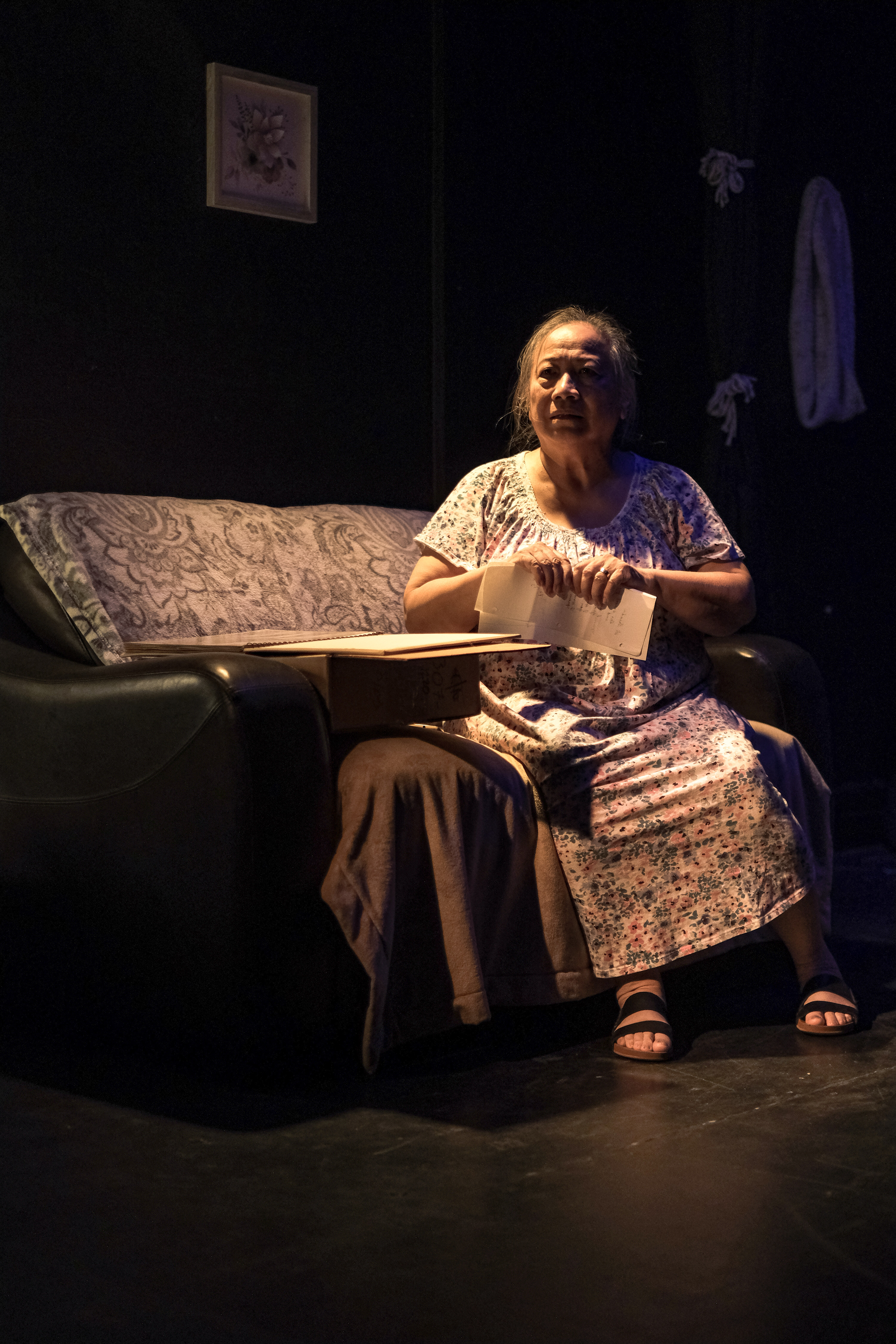
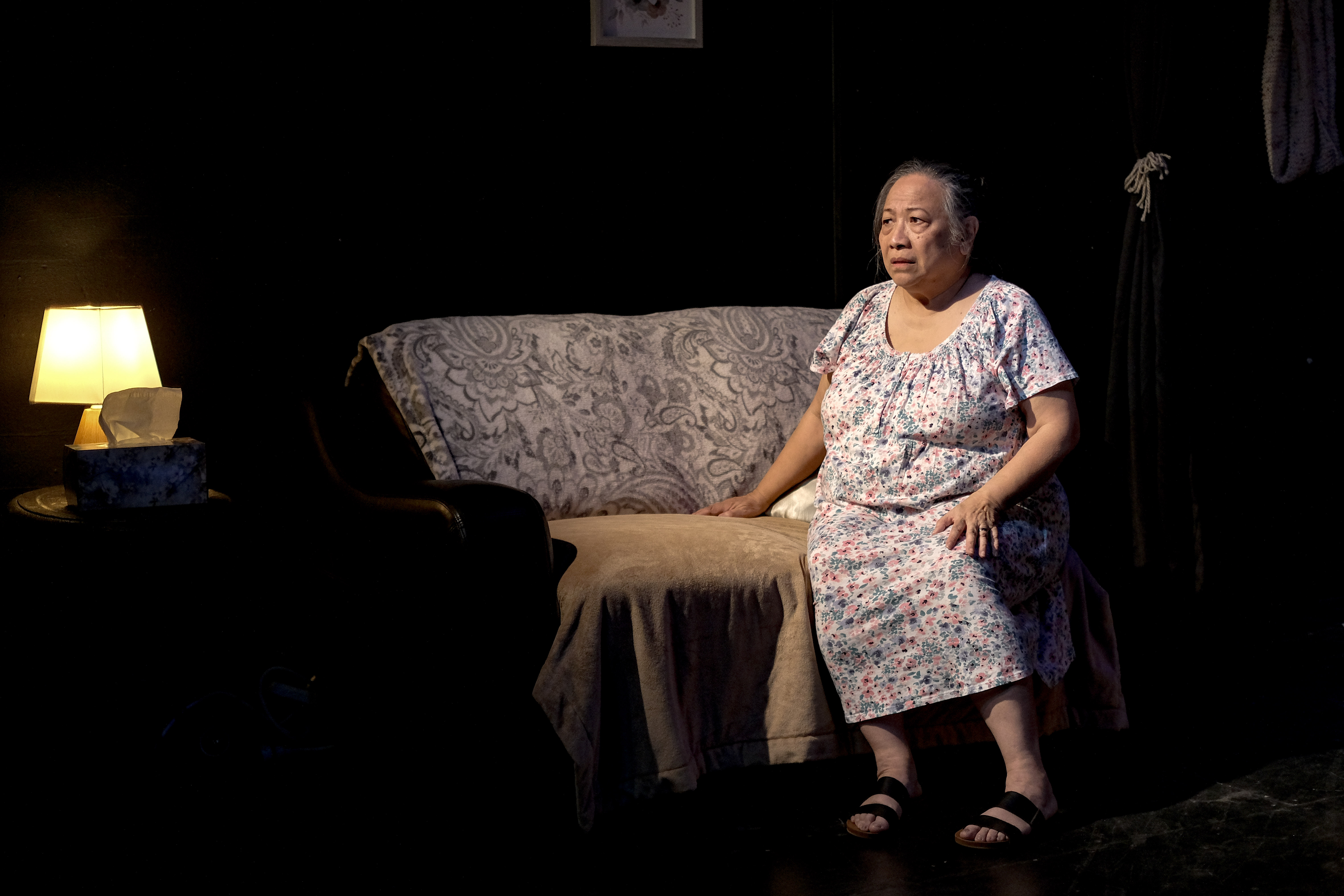
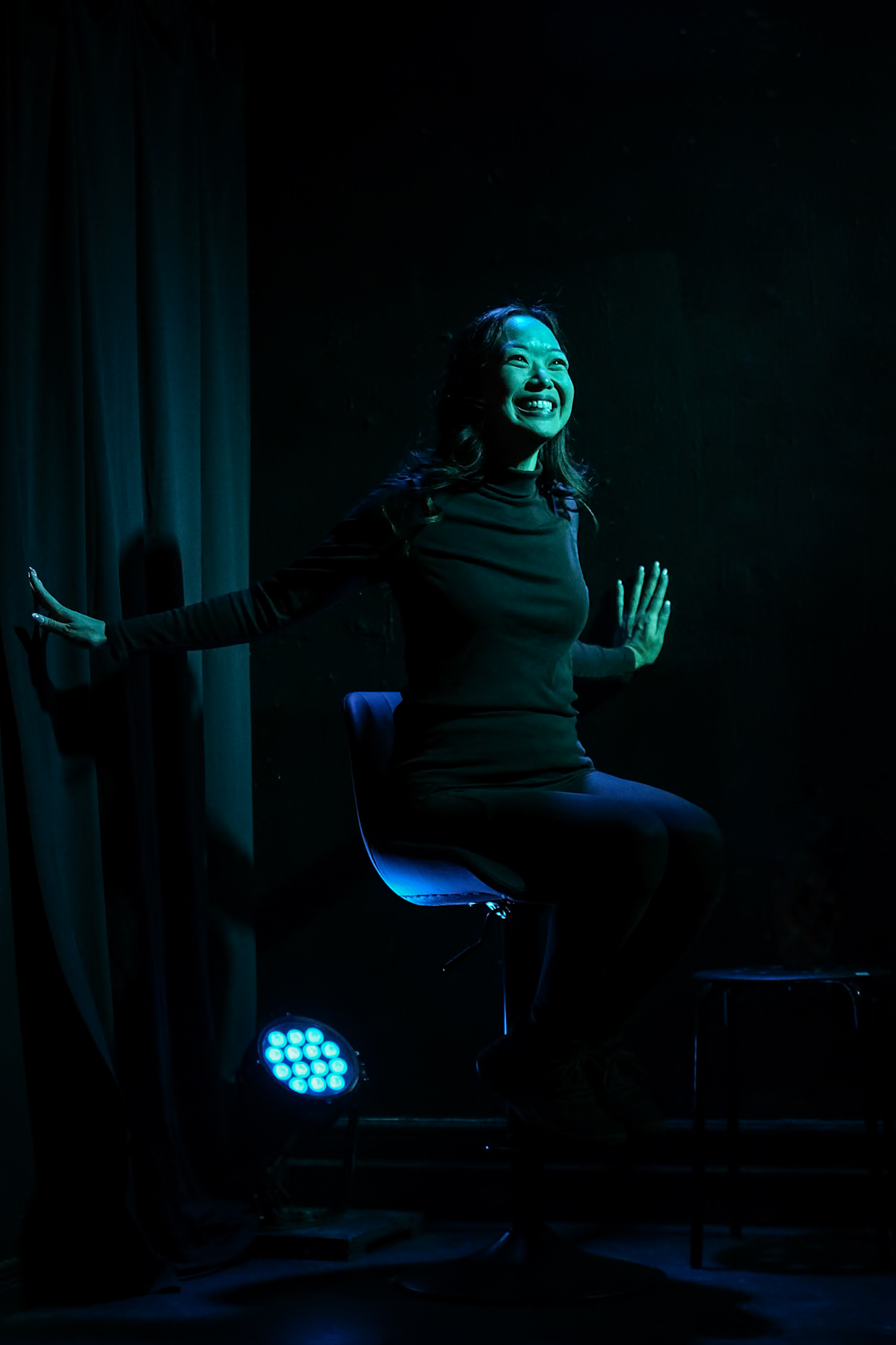
When Brenda first meanders in, singing and moving her body playfully to her inner “Tequila,” Fe’s shuffle carries a grandmotherly charm that makes the character immediately inviting. She feels gloriously kind as she settles into her space with the familiarity of someone who knows every corner of it. Yet there is something amiss in the way she struggles to type, repeatedly backspacing over words, correcting herself with a building frustration. Then the voice arrives from within her device. April Leung (Soulpepper’s Yellow Rabbit), seated in the corner and swivelling around to address Brenda whenever the camera is activated, gives Aye Caesar a wonderfully controlled presence. Her name turns out to be ‘Aye Caesar,’ she tells the surprised Brenda, using subtle vocal shifts and mechanical modulation to create a customer service representative who sounds attentive, patient, and increasingly personal. She is the perfect helper, painting a very human picture of herself as both a curious conversationalist and an adventurous digital nomad, all of it a carefully constructed persona designed to draw this lonely woman in. Christopher-Elizabeth’s sound and lighting work stealthily around them, helping turn each search, response, and rotation of the virtual assistant into a small theatrical event. As Brenda begins shopping for a bottle of Royal Violet ink and an almost impossibly expensive one-of-a-kind notebook, the late-night exchanges become increasingly personal. Fe allows us to watch this elderly woman open a door that she has largely kept closed to the outside world, and we automatically lean in, wondering.
That loneliness becomes the heart of the play as Brenda begins sorting through a shoebox of memories, transferring pieces of her life into newly purchased scrapbooks and notebooks as she tries to tell the story of her marriage and the man she has lost. Fe (Crow’s Uncle Vanya) is captivating and engaging in the role, giving complex physical shape to the emotional history of a woman whose world has become increasingly confined by grief, age, physical pain, and isolation. The intimacy of Red Sandcastle Theatre, with the audience sitting so close to the action, makes these moments especially affecting, and Tanisha Taitt’s direction and set design give Brenda’s home a lived-in quality without distracting from the two people at the centre of the story. The notebooks also become increasingly important objects as Brenda searches for an order to the memories she is trying to preserve. Her questions to Aye Caesar about where those memories should go reveal how quickly this digital stranger has become part of the process of understanding her own life.
And here is the rub. I spent much of the first half waiting for something to go terribly wrong. The consent questions are unsettling, and Brenda’s willingness to give this unseen assistant permission to hold her accountable for almost anything that might go wrong creates an expectation of danger. That feeling becomes especially uncomfortable when Brenda begins gulping down pain medication and her grip on reality becomes increasingly uncertain. As someone who is deeply connected to the way elderly people living alone can become vulnerable to the kind of people who recognize that loneliness as an opportunity, I found myself wondering whether this was where this play was heading. Instead, when Aye Caesar fails to load one late night, and another voice steps into her place, the play takes a more personal and psychologically complicated path. The Royal Silk Road notebook allows Brenda to dream, while the Red Dragon notebook becomes connected to a deeper pattern of memories, experiences, and need. The shift works because Fe and Leung never allow the connection between Brenda and Aye Caesar to become merely technological. There is genuine affection in the way these two performers listen to one another, and we find ourselves stumbling a bit ourselves, questioning our conclusion about how human Aye Caesar truly is.
Watching Aye Caesar is like giving consent when we aren’t exactly sure what we are agreeing to, as we see and understand how artificial intelligence is already becoming woven into our everyday lives. My mind kept thinking about ‘Muse,’ the artificial assistant Instagram keeps trying to convince me to use, right down to the carefully designed little Pac-Man character meant to make the technology feel harmless and friendly. I want none of it, yet watching Brenda become so quickly connected to Aye Caesar makes the appeal much easier to understand. The play has a genuinely powerful idea at its centre about technology entering the emotional spaces created by loneliness. The humanoid face masks, stolen from real people, make that intrusion even more unsettling, and Fe gives Brenda enough warmth, humour, confusion, and vulnerability to make that connection feel deeply human and deeply uncomfortable. The play succeeds in making that connection both beautiful and uncomfortable, but I must admit I wanted it to push further into the darker possibilities raised by the repeated consent questions
Still, the emotional core of Aye Caesar, produced by Stakes & Embers and Carolyn Fe Productions in association with Eldritch Theatre, is Brenda sitting in her home with a shoebox of memories, a collection of beautiful new notebooks, and a voice inside a computer that is willing to listen. She is trying to give some kind of order to a life that grief, age, pain, and isolation have left scattered around her. The unsettling part is how quickly that order begins to come from a humanoid A.I. assistant, and how comforting that mechanical device can become when there is no one else there to answer. That is where Fe’s play wisely hits hard. The consent questions may have hinted at a darker thriller than the play ultimately delivers, but the more intimate question underneath them is far more human. What happens when the person who is willing to listen and help is no longer a person at all?