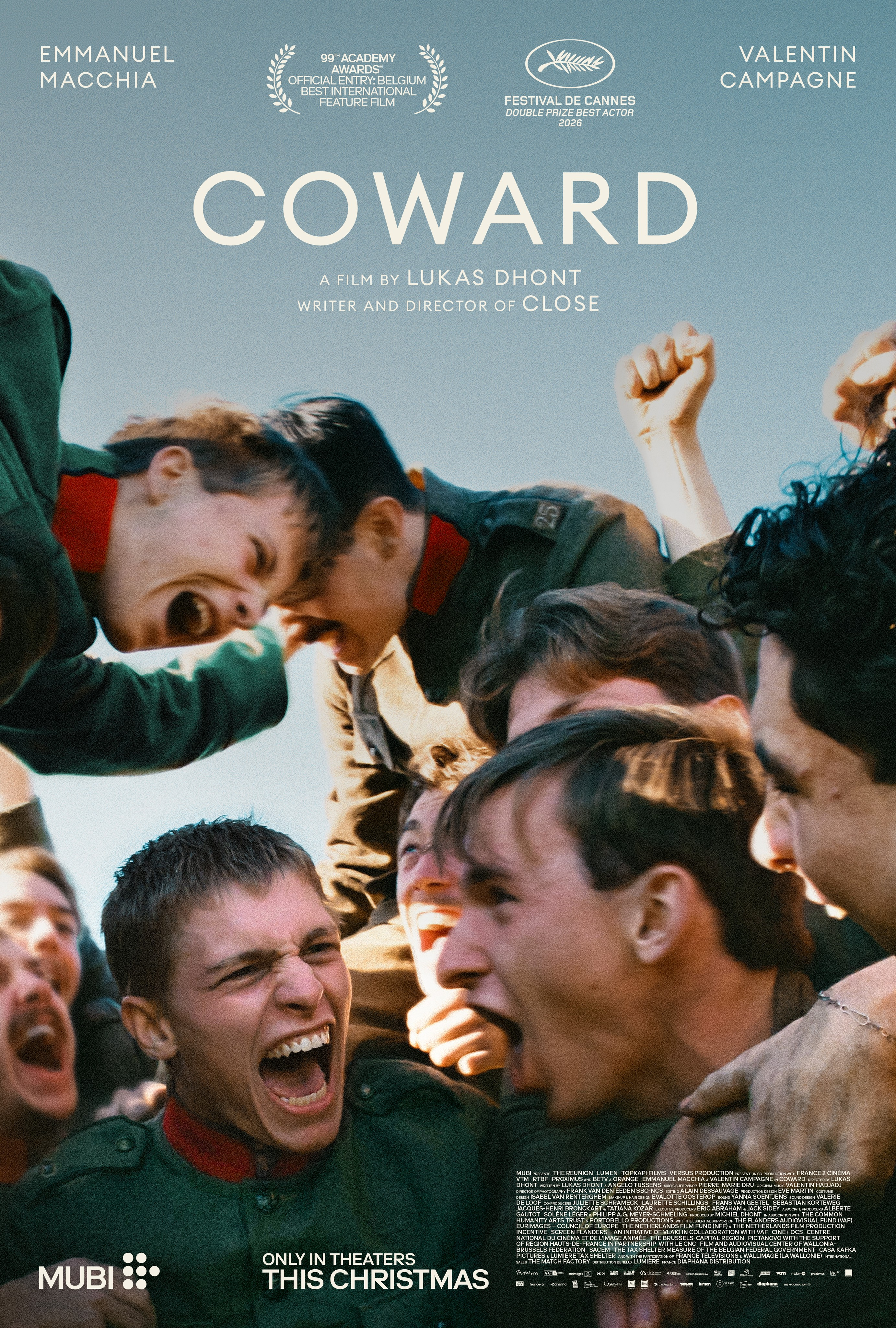
A Frontmezzjunkies TIFF film review: Lukas Dhont explores the fragile courage, private longing, and fleeting freedom found amid the horrors of the First World War.
By Ross
I could hardly wait to get to my first early-morning press screening at TIFF51, and I couldn’t have been happier that “Coward” was the film I chose to begin this year’s festival. After the anticipation and the last-minute decision that would determine my first TIFF screening, I found myself sitting in the dark, completely absorbed in a story that reached straight into my heart. Directed by acclaimed Belgian filmmaker Lukas Dhont, who co-wrote the screenplay with Angelo Tijssens, this World War I romance quickly became one of the festival’s most affecting discoveries for me, and it’s no surprise to me that it is now Belgium’s official submission for the Academy Awards. Set in 1916, the film introduces us to young Belgian soldiers arriving at the front full of adrenaline and camaraderie, convinced they understand the purpose of the war. They sing of smiles, smiles, smiles, as they look to one another for reassurance. They carry the optimism of boys who have yet to understand the horrors waiting for them. Watching their faces, I couldn’t help thinking about how little they could possibly know about what lay ahead, or how quickly that youthful faith would be tested.
The sounds of war begin to rattle in the distance, and the soldiers’ confidence gives way to an unease that is difficult to hide. Among them is Pierre, beautifully portrayed by Emmanuel Macchia, a brawny farmboy whose silence earns him the nickname “quiet mouse.” He is new to this world, watching the men around him for clues about how to behave and trying to find his place within a situation that seems to demand a kind of bravery he has not yet learned how to perform. When the young soldiers are sent to collect identification tags from the dead, the task becomes almost unbearable. Every body they encounter belongs to someone who was recently standing beside another young man, and every face in the group seems to understand that the same fate could be waiting for them.
Frank van den Eeden’s cinematography keeps us close to the soldiers’ faces, where the fear they are struggling to contain becomes painfully apparent. The film’s unique framing adds to that feeling of confinement, keeping our attention on the men and the immediate world around them. Even when violence remains outside the frame, the sounds of war keep its threat pressing in on the men. Valentin Hadjadj’s score gives the quieter scenes a tenderness of their own, allowing the music and the growing connection between the men to find room amid the sounds of war.
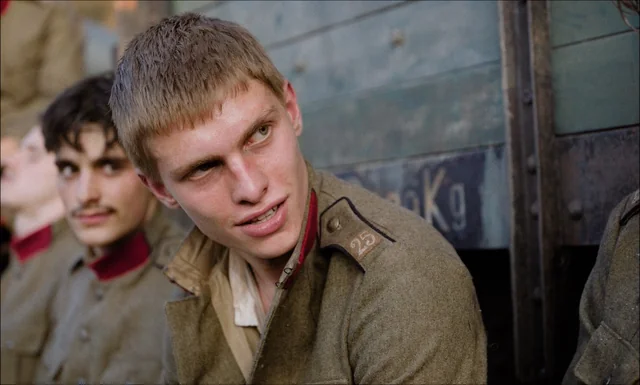
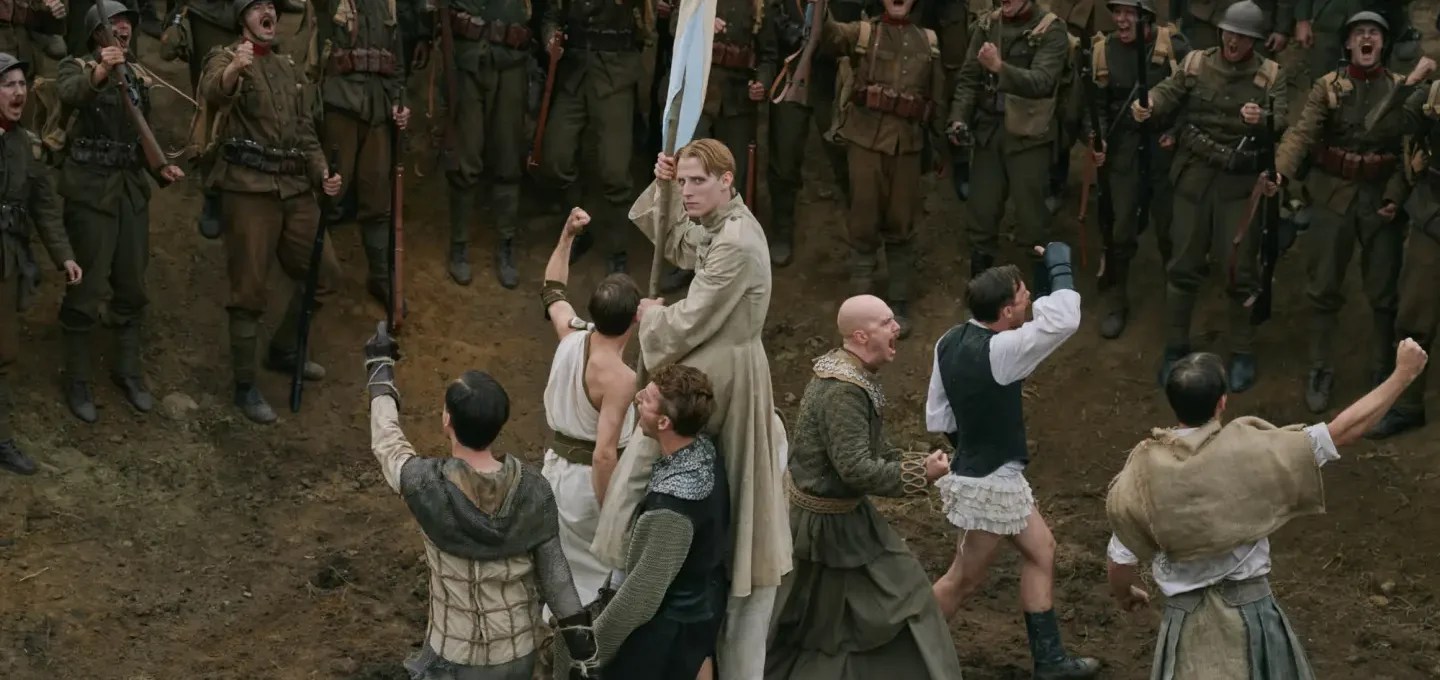
Pierre’s watchful silence gives Dhont an affecting way into the film’s exploration of masculinity, sexuality, and courage. He takes in each unfamiliar sight with the wary curiosity of someone who has not yet learned what the world expects of him or how it sees him. Among the entertainments arranged for the troops are performances by soldiers dressed as women, part of the theatrical diversions intended to lift morale amid the misery of the front. The revues offer an unusual space for self-expression, even as the men remain subject to the rigid expectations imposed by military life. Orders such as “Stay on your feet, sissies” reveal the casual homophobic cruelty with which those expectations are enforced. The insult cuts deeply because the men in authority have the power to decide what courage is supposed to look like, and humiliation becomes one of their tools for keeping everyone in line. Pierre is still trying to understand what is expected of him, wondering what his fear reveals about him and how readily the men around him might turn uncertainty into an accusation. I found myself watching him closely, aware of how much he communicates through his face and the hesitation in his movements.
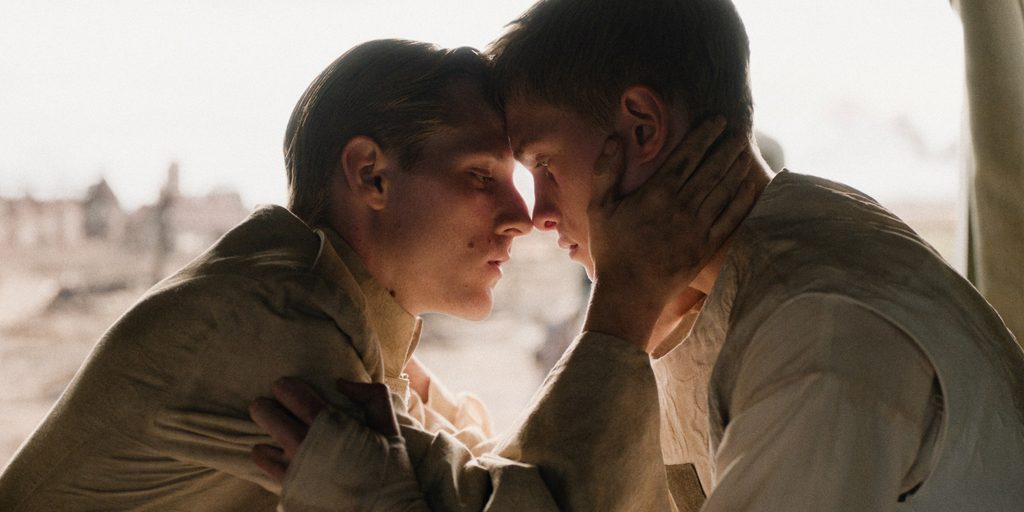
Then Francis, portrayed by Valentin Campagne, enters Pierre’s world, bringing music, performance, and the possibility of a connection that reaches beyond the immediate demands of survival. Francis, the son of a tailor, is the enthusiastic leading performer of a group of soldiers known as the Band of Rejects, whose impromptu revues offer their comrades a chance to step briefly outside the misery surrounding them. Eve Martin’s production design and Isabel Van Renterghem’s costumes help establish the world of these performances, where the men can transform themselves and make room for a little imagination within the confines of military life. When Pierre encounters Francis singing a love song, the film opens a small space in which the war’s terrible demands briefly loosen their grip. Francis tells him, “We are free here,” and the complicated beauty of that declaration falls on Pierre like fake snow from above the stage. The revues create a place where these men can express something the world around them gives them little room to explore. For Pierre and Francis, that freedom begins to take on a more intimate meaning as their attraction develops. Their growing affection is tender and vulnerable, held within a fragile pocket of possibility that the violence outside can easily destroy.
Macchia and Campagne are the emotional centre of “Coward.” They give Pierre and Francis distinct inner lives, allowing their attraction to develop through glances, hesitations, and moments of confidence. Their joint Best Actor honours at Cannes recognise performances that communicate so much through what remains unspoken. Macchia gives Pierre a frightened optimism that I found deeply affecting. His quietness holds a struggle between the desire to belong, the fear of being judged, and his determination to believe that love and companionship might still be possible amid the violence. Campagne brings Francis a spirited, flamboyant energy, embracing the freedom of performance while letting us glimpse the vulnerability beneath his confidence. Dhont directs their connection with great sensitivity, giving their relationship room to develop while keeping the war’s brutality firmly in view.
What moved me so deeply about “Coward” is the question tucked inside its title. Who gets to decide what a coward looks like when every soldier is frightened, when men in positions of authority use humiliation to define bravery, and when simply holding on to one’s humanity demands so much? Pierre’s struggle is written across his face, but so is his hope. He is a young man trying to understand himself while the world around him insists on telling him who he should be. As the story approached its final scene, I found myself holding my breath alongside Pierre, waiting and hoping until he finally made his intentions clear. Then he walked away, seeming surer of himself than the innocent young man we first met. For all the fear and brutality surrounding him, Pierre keeps reaching toward a life in which he can be seen, accepted, and loved, even when that desire puts him at odds with the rules governing the men around him. That brave belief is what made this film feel so deeply personal to me.