
The Ontario Theatre Review: Blyth Festival’s The Last Mayor of Rusty River delivers big laughs, bluegrass energy, and a cat with mayoral ambitions
By Ross
When a strong whistle blew, summoning the musicians and a handful of guitars onto the stage, I knew I was in for a lively evening. The festive opening song launches The Last Mayor of Rusty River at the Blyth Festival with a wonderfully infectious spirit. The cast invites us into their town, to “Come by, say hi, we’ll be here until the day we die.” There is something wonderfully direct about that welcome and the wink. This is a show that knows exactly what kind of evening it wants to provide: big laughs and catchy bluegrass music, mashed with spirited political nonsense and a town meeting that somehow turns the question of a municipal mascot into an increasingly ridiculous feasibility study. I spent much of the evening smiling, laughing, and enjoying the sheer energy of the thing, even while occasionally hoping the political arguments would stop circling the same ideas and simply get on with the next joke and the next song.
Created by David Scott and director Gil Garratt, with original music by John Powers, The Last Mayor of Rusty River calls to order a small-town municipal meeting and election that goes completely off the rails almost immediately. Two new and frustrated councillors, Tim and Tina, have become fed up with longtime mayor Larry Fletcher, whose political style involves plenty of talking, very little resolution, and an apparent talent for ensuring that decisions never interfere with his own financial interests or those of his friends. Tim’s answer to the ‘Honorable’ Fletcher’s shenanigans is Captain Whiskers, a 19-year-old cat nominated for mayor as a protest. But long before the feline campaign can even become the town’s biggest problem and spectacle, the council must answer the burning question of whether Rusty River’s mascot should be a red squirrel or a chipmunk. Naturally, the eventual solution is to discuss the possibility of conducting a feasibility study about adopting some sort of rodent.
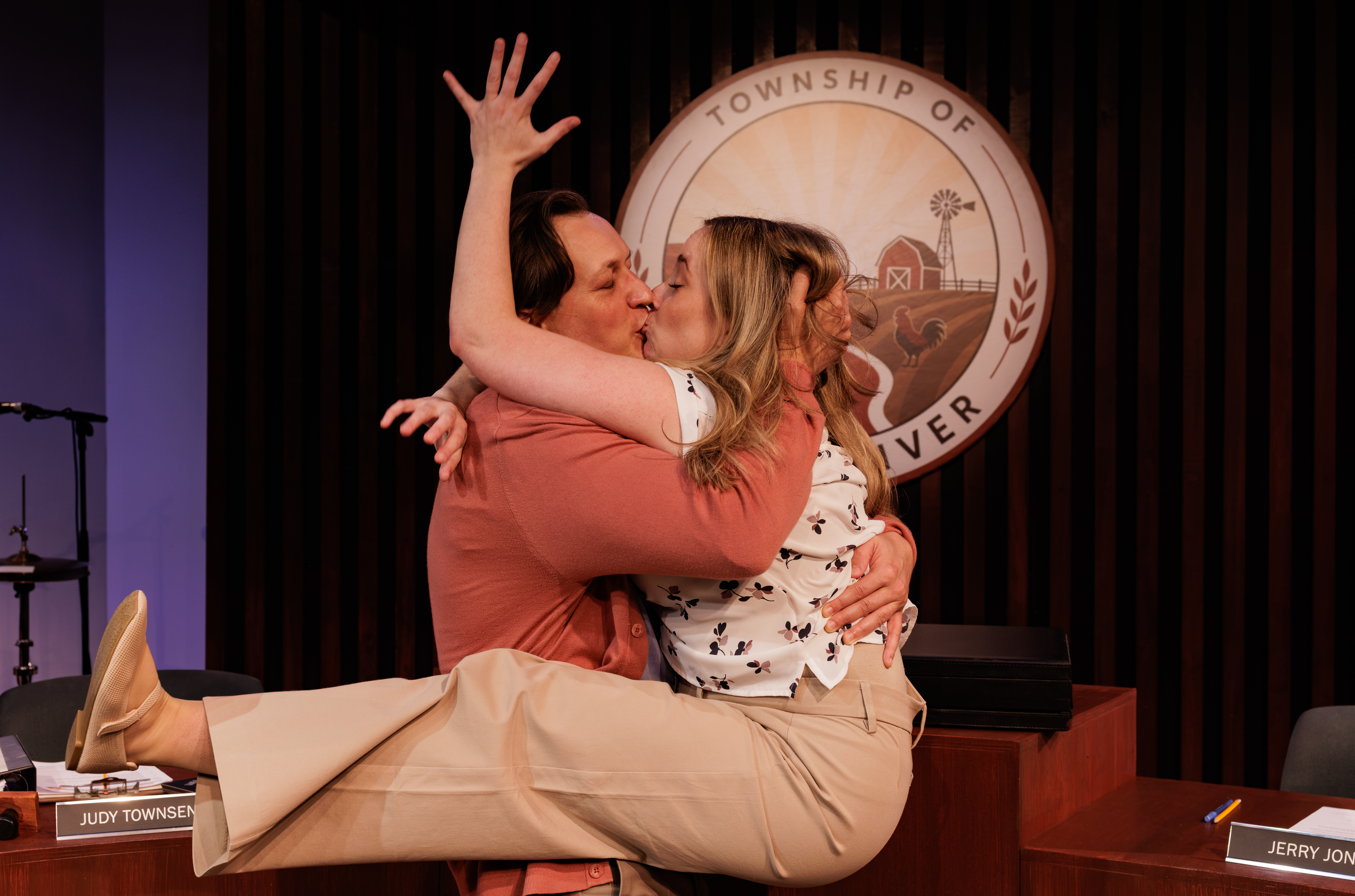
Cameron Laurie brings an appealing air of frustration to his brash and impatient Tim, one of the younger councillors who has reached the end of his patience with Larry’s political maneuvering. Also at the end of her rope is the terrific Hallie Seline as the exasperated Tina. Seline gives her a spirited determination that makes the character’s exasperation especially funny but completely understandable. Their chemistry gives the council debates much of their spark, although their most interesting negotiations seem to happen after the rest of the council has gone home.
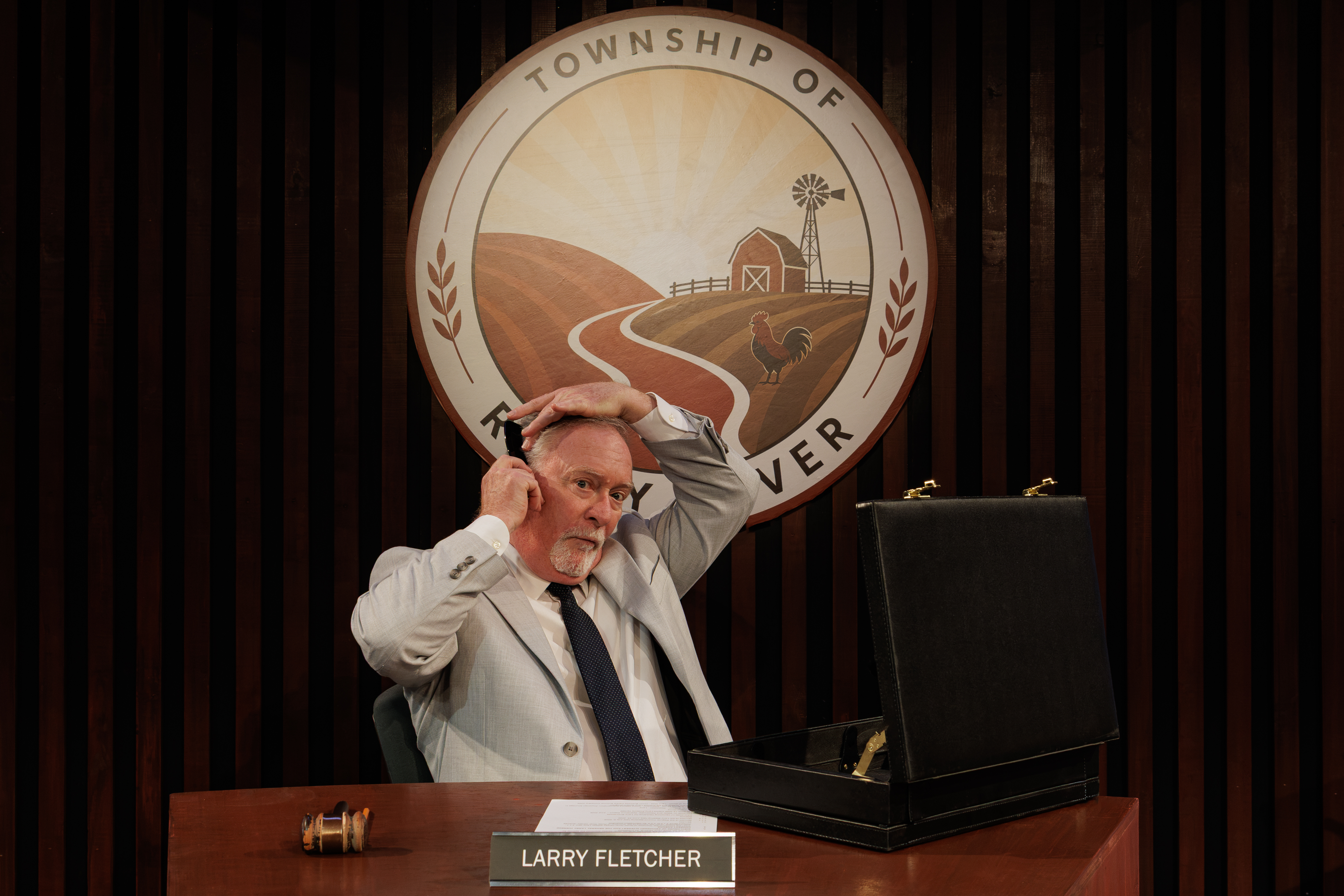
As the longtime mayor, Larry Fletcher, Benedict Campbell (Tarragon’s Withrow Park) has a great deal of fun making the man an easy target for political parody with his bombast, self-interest, and pompous certainty. There is a broadness to the character that the production embraces wholeheartedly, and Campbell commits to it with the confidence of a veteran performer who knows how to land a laugh. Larry’s habit of dismissing questions, protecting his friends, and finding ways to keep the local reporter, Harmony, away from information gives the character plenty to work with. His repeated mispronunciation of her name is particularly cheeky, turning what could be a small detail into another little source of comic irritation. The satire is hardly subtle, but the audience knows exactly where the joke is going, and Campbell makes the journey enjoyable.
David Kirby is equally entertaining as his political parrot Jerry, Larry’s appointed council member and enthusiastic political yes-man. Kirby gives Jerry a wonderfully sincere willingness to support, second, and defend whatever Larry happens to be saying, even when the argument has become completely absurd. That sincerity is important to the show’s humour. The characters are not standing outside their own ridiculousness and winking at us. They are living inside it, passionately debating, campaigning, scheming, and defending the political machinery of Rusty River as though the fate of civilization depends upon it.

Seated center in the chair reserved for Media, right in the heart of the audience, Brontae Hunter brings a lively, slightly wacky determination to Harmony, the young reporter repeatedly trying to get information out of Larry. Her position makes her part of the audience’s experience of the council chaos, watching and reacting to the proceedings from within the room she is supposed to be covering. Robin Craig, seated beside the mayor, is wonderfully funny as Judy, often communicating her exasperation with little gestures, including dropping her head toward the table as the debates spiral. Both performances add personality to a council chamber that could otherwise become a sea of political argument. The entire ensemble approaches the town’s absurdity with such joyful sincerity that the comedy never feels cynical. Everyone appears to be having a great time playing inside this peculiar little town, and that enjoyment reaches the audience.
The music is one of the show’s greatest pleasures. John Powers’ original bluegrass-fuelled songs give The Last Mayor of Rusty River a festive musical identity, and music director Landon Doak keeps the performances lively and inviting. The songs do not necessarily carry the plot forward in significant ways, often functioning as joyful interludes between the political debates, but that is hardly a complaint. They give the audience room to exhale, keep the energy moving, and provide some of the evening’s most immediately enjoyable moments. The music adds a warmth and playfulness that suits the show’s small-town setting perfectly.
Yet, the show’s biggest weakness is also tied to the thing it enjoys most. The Last Mayor of Rusty River has plenty to say about small-town politics, hypocrisy, self-interest, political posturing, and the peculiar ability of people in power to keep talking without actually changing anything. The problem is that it keeps returning to those same points. Both acts occasionally become bogged down in the combative repetition, with characters circling back to the shadiness of politics and Larry’s behaviour after the poke has already been made. The joke works. It gets a laugh. Then it comes around again. And again. The material really could use a strong edit, particularly in the longer stretches of political debate, where trimming repeated arguments would allow the sharper jokes and the entertaining musical numbers to land with even greater force.
The Last Mayor of Rusty River may occasionally take the scenic route to its next joke, but it is an easy show to enjoy. The premise is cheerfully ridiculous, the cast plays it with complete commitment, and John Powers’ music gives the whole thing a buoyant rhythm that carries it through the longer stretches. This is not Shakespeare or Sondheim, and it does not need to be. Its pleasures are simpler and wonderfully direct: a ridiculous cat campaign, a debate over squirrels and chipmunks, politicians talking themselves in circles, bluegrass songs, and a community gathering to argue, sing, laugh, and somehow keep going. There is a genuine affection underneath all the parody, and that warmth gives the production its particular Blyth Festival charm. On a summer night, with the music still ringing in my ears, that is a pretty lovely small-town place to be.

 front mezz junkies