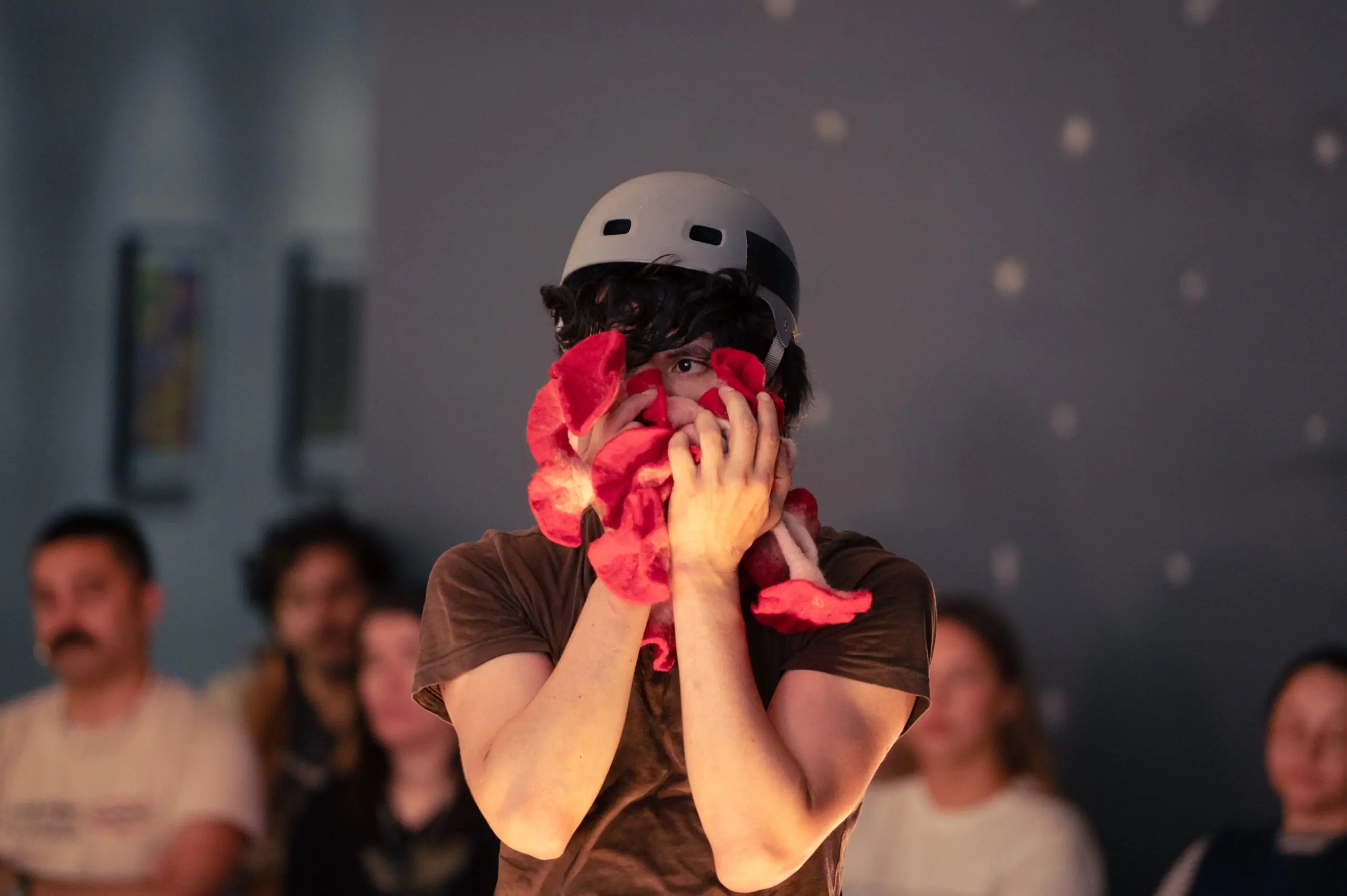
Frontmezzjunkies reports: Marcus Merasty uses poetry, movement, sound and a green chalkboard to explore Indigenous identity, memory and what cannot be erased
By Ross
I am still trying to decide what Marcus Merasty wanted from me during the first long stretch of Golden Rez Dog, part of Toronto’s annual SummerWorks Performance Festival. By the time I take my seat at The Citadel, Marcus Merasty has already smudged the room with incense and his compelling energy. Church bells ring out as a large green rectangular platform lies discarded, tilted and blank in the space, looking somewhere between a fabricated dog relief centre in an airport and a thrown-away school chalkboard left behind at an abandoned country schoolhouse. The image immediately carries the historic weight of the Residential School system and its attempt to erase Indigenous people, language, and history.
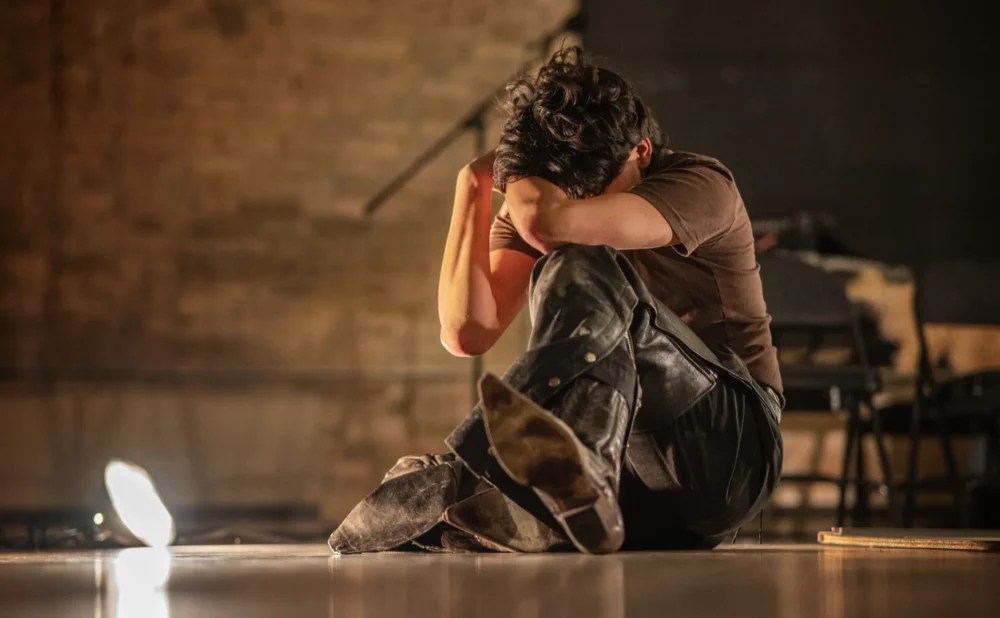
Merasty, as both the choreographer and performer, stands before it, back to our prying eyes, cinematically lit in silhouette. We see the toughness of his black leather pants, boots, and tee as he kneels down, turned away, and begins to write on the chalkboard platform, teasing us with its meaning and his words. We cannot see what he is writing. Line after line appears beneath his hand, and the longer he continues, the more the silence around those hidden words becomes part of the performance.
Eventually, the writing is complete, although not exactly revealing itself to us. Those scrawled words are drawn from The Old Rez Dog, a poem by his aunt, Francine Merasty, and they are just one of the two literary sources behind the piece alongside Lucius Apuleius’ The Golden Ass. The words matter precisely because we have been denied access to them, and when Merasty eventually obscures, smudges, and erases them with his own body, the act takes on a painful, distinct resonance. What has been written can disappear, and what has been passed down can be obscured, especially when that writing is about Indigenous culture, language, and spirituality. The Residential School system tried with all the force of government and church behind it, but what has been erased can still live inside the person carrying it. That idea floats in the air like the incense Merasty used, tasking us to breathe it in deeply.
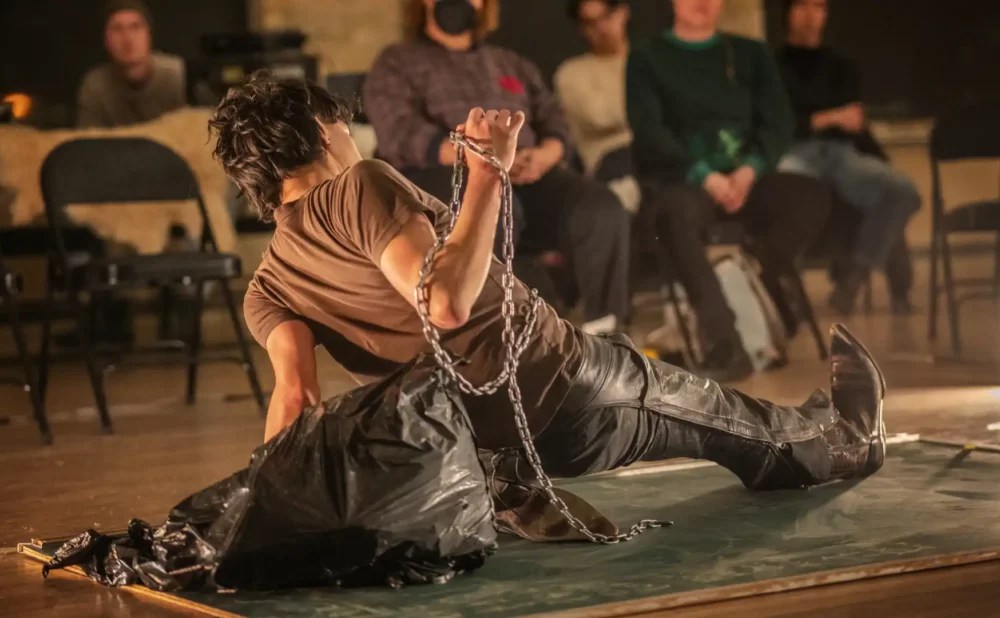
Merasty throws a half-filled black garbage bag over his shoulder as if he is carrying the accumulated weight of a history that must not be discarded, and the performance begins to shift from a test of our patience and curiosity into something more intimate and unsettling. The hypnotic soundscape by George Stamos deepens that feeling, layering street sounds, spoken words, country guitar, electronic textures, and recordings of Merasty’s grandmother into an intoxicating sonic world. Country twangy guitar goes in and out, sharply and defiantly. “If you lose your heart,” the voice sings, and Merasty tries to suggest a way to find it. The voices of the past, layered with threat and care, are not presented as decoration. They seem to surround the body with ancestral energy, attempting to carry them forward out into the world.
That body eventually begins to change. Merasty’s body collapses as the transformation into the “rez dog” arrives through movement that refuses anything cartoonish or literal. A shaking hind leg, heavy stomping, and the metallic strike of tap shoes against the chalkboard create a physical vocabulary that feels angry, controlled, and increasingly hypnotic. The green platform becomes an obscured instrument beneath him, the sound of his feet joining Stamos’ electronic landscape as the human figure begins to inhabit another form. The transformation draws on the piece’s Cree storytelling traditions while questioning what happens when stories, identities, and knowledge move through generations. ‘Rez dog‘ has carried a derogatory connotation of displacement and danger, yet Merasty reclaims the term and connects it to resilience, companionship, and ancestral knowledge.
Golden Rez Dog can be demanding, and there are moments when its slow pace pushes hard against the limits of an audience’s attention. I watched people begin to squirm in their seats while Merasty continued to write, and I found myself wishing I could read the poem that was being created in front of me. It is an unusual demand to make of an audience. We have to sit with our impatience and our need to understand. That discomfort is part of what makes the work so compelling. It asks us to become curious rather than simply expect the performance to deliver its meaning on command. It asks us to take responsibility. Its imagery is powerful and animalistic, and its movement can feel difficult to decode, but there is a deliberate intelligence in that difficulty. Merasty is asking what happens to knowledge when it is carried by bodies rather than preserved safely on a page, and what happens when the stories inherited from our families continue to change shape inside us.
The chalkboard begins blank, fills with words we cannot read, and is eventually covered and erased by the very body that wrote them. Around him, the voice of his grandmother, the sounds of the outside world, and the metallic percussion of his own movement create a history that refuses to stay still. Golden Rez Dog does not offer a simple transformation from human to animal and back again. It creates a cycle in which stories, memories, and identities are continually being carried forward and reshaped. Merasty leaves us with a body that has absorbed generations of knowledge and trauma, then asks us to look closely enough to recognize the cost of what survives inside it.