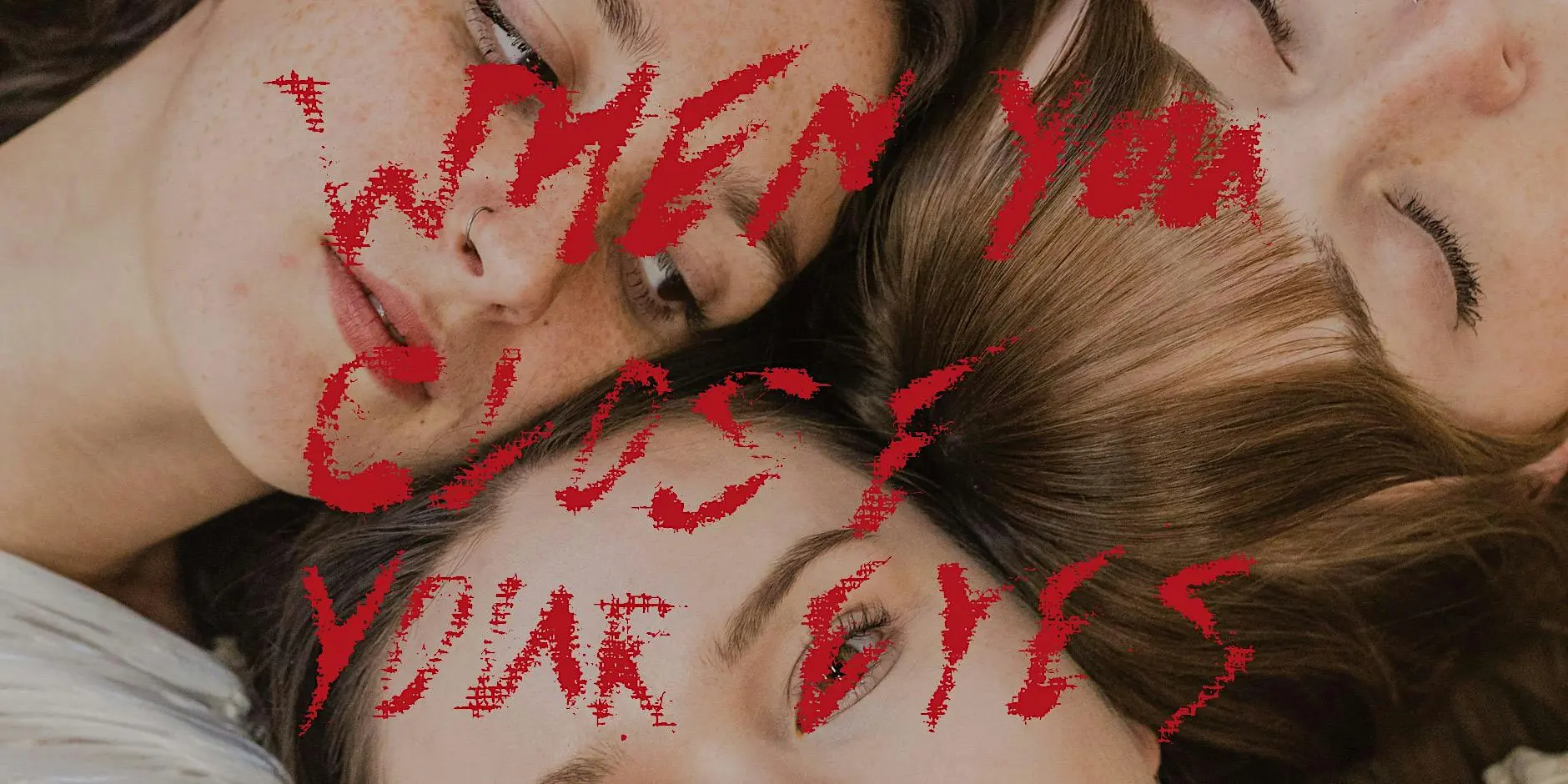
The Toronto Theatre and TIFF Film Review: Pepper’s Ghost Productions’ sapphic horror musical finds an unsettling companion in Guy Nattiv’s TIFF film, as both examine the vulnerability of women searching for a way out of their pain.
By Ross
I couldn’t stop thinking about the film, “The Liberation,“ as I watched When You Close Your Eyes, the new staging from Pepper’s Ghost Productions in Toronto. This may seem odd to say, but there are good reasons for this. Guy Nattiv’s film, and its portrait of a lonely, emotionally wounded woman being drawn into the orbit of a charismatic cult leader, has stayed with me since I saw it at TIFF 2026. In the film, Carrie Coon (MTC’s Bug) gives a devastating performance as Rita, a woman carrying a lifetime of pain who finds herself completely captivated by this mysterious woman who wanders into her bank one day to open an account. Ricki, played with unnerving charm by Lily James (Garrick/West End’s Romeo and Juliet), offers Rita a new language for understanding her unhappiness, a promise that she can leave her past behind, and finally belong somewhere. “I am not my past, I am ready for my liberation,” Rita is encouraged to proclaim. Is this liberation, or is it another form of captivity, built upon the vulnerabilities of women who are already feeling lost, unseen, and desperately alone? That same question runs through When You Close Your Eyes, a somewhat campy, gruesome, darkly funny musical horror story about a group of young women in a bleak little town and the newcomer who seems to know exactly what they need.
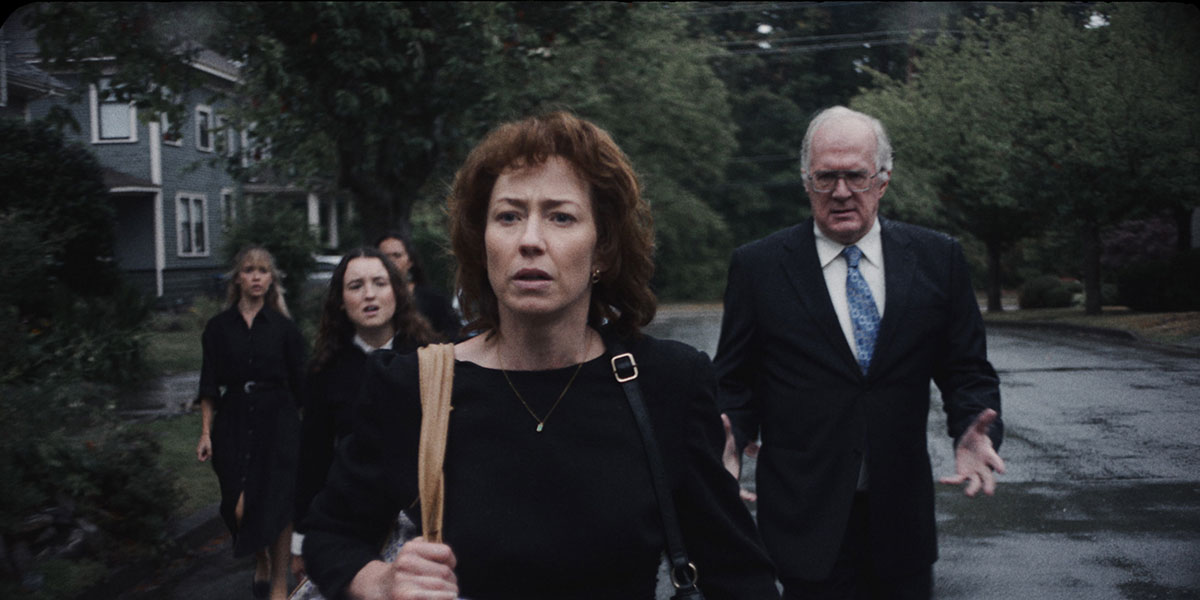
Nattiv’s film, written with Noa Berman-Herzberg and loosely inspired by the real-life experiences of his grandmother, takes place in early 1980s New Jersey, where Rita’s ordinary suburban existence is simply accepted as a painful chapter in her family’s history. A survivor of the Holocaust, she carries the trauma into her everyday life as a wife, mother, and assistant bank manager, where it remains largely unacknowledged. The ticking of a clock draws us into her world of doing time as she sits, breathing deeply, hoping to release the tension held so tightly in her body. She attempts to describe to her loved ones a dream of abduction and the awful loneliness at its centre. “No one is there,” she says. “It’s me, alone, still waiting,” and we see how that is the truth of her unconscious and conscious life. Coon captures that suffocating isolation with extraordinary emotional precision, never making Rita seem foolish for being drawn toward someone who appears to recognize her suffering. James is truly sensational as Ricki, whose ability to read the insecurities of potential recruits allows her to exploit their vulnerabilities with unnerving ease. She invites Rita to “present yourself to us,” offering the attention and acceptance that have been missing from her life. The film understands the particular seduction of being seen and attended to by someone who seems to know exactly what you need to hear.
What makes “The Liberation“ especially affecting is the ordinariness of the family Rita leaves behind. Her husband, beautifully portrayed by Tracey Letts, and her daughters, Bella (Ella Cooper) and Jo (Odessa Young), love her, but they have become accustomed to her sadness, her anxiety, and the ways she has learned to manage herself. Cooper and Young give the daughters a convincing mixture of frustration, fear, and desperation as they undertake the long drive to find their mother and bring her home. Their search provides the film with an emotional anchor, while Rita’s seduction by Ricki and the gradual tightening of the commune’s hold remain its most compelling dramatic thread. Nattiv takes a patient approach to the psychological mechanics of that relationship, allowing the early rituals and promises of Harmonia to unfold within a grainy, lived-in period atmosphere. I did have moments when I found myself questioning how the organization operates and how its members are controlled, and the final movement of the film shifts into a rather neatly resolved thriller involving Rita’s diabetic daughter. That resolution is a bit too tidy for the raw emotional material that has preceded it. Yet Coon, James, and Cooper give the film an emotional centre that holds firm even when the storytelling becomes less convincing. The promise of healing can be extraordinarily seductive when someone has spent years feeling that nobody has noticed how much they hurt.
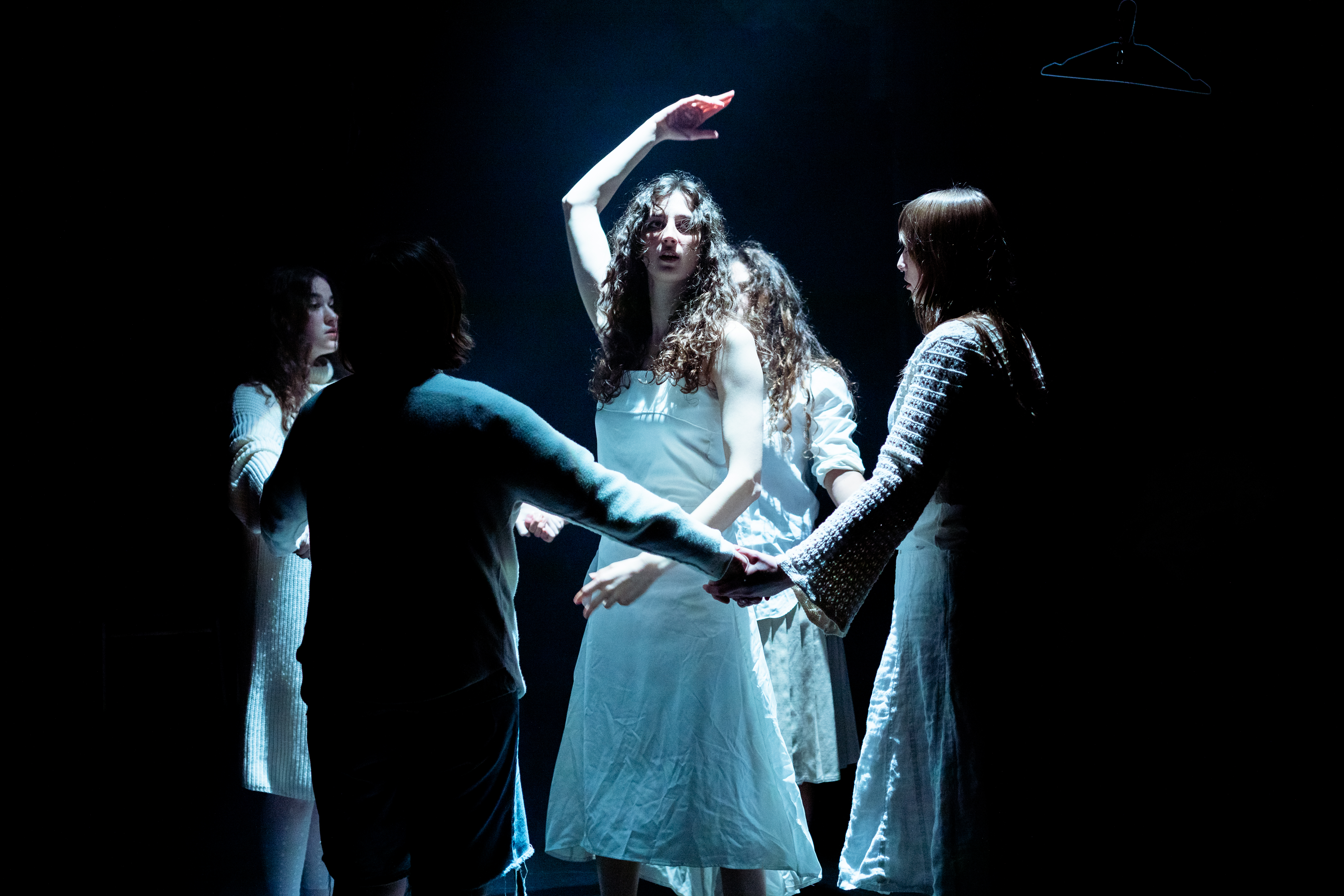
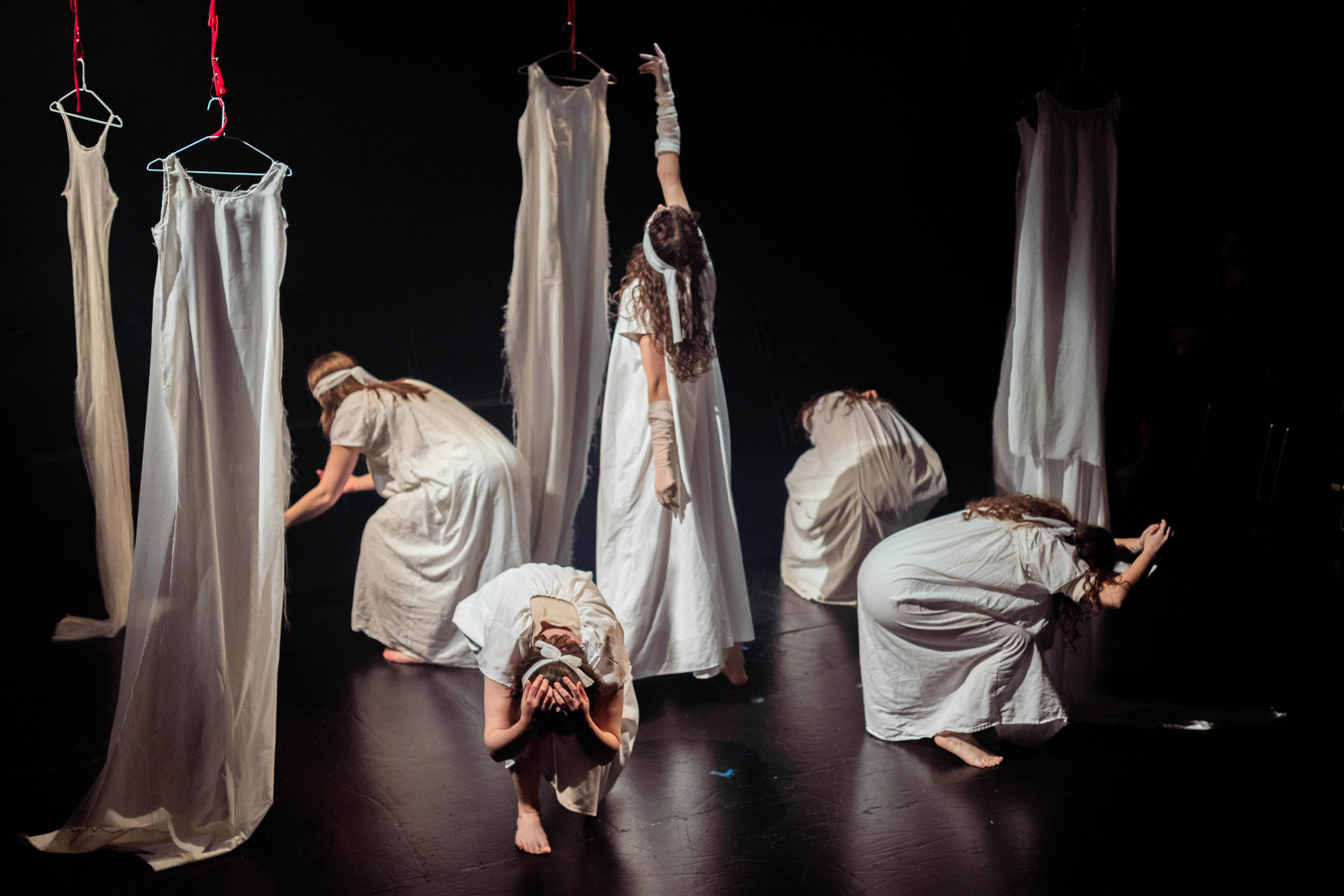
The 2026 return of When You Close Your Eyes builds a similar atmosphere of desperation and mounting unease from its opening moments. Five white gowns hang from hooks in a seductive circle, and as the lights dim, chanting and heavy breathing begin to fill the space as female bodies, blindfolded, move through the hypnotic choreography of a mother moon ritual. The women gyrate and sing “We Are Born, We Are Raised,” and unleash screams that make their intentions unmistakable and disturbing. The piece carries an echo of the teenage intensity and emotional urgency of the musical Spring Awakening, yet this captivating musical, written by Jessa Richer, with additional compositions by Jason Kokkovas, begins its modern-day exploration of young women who feel trapped by everything they have ever known.
Vera, played strongly by Josie Smith, arrives in town with the compelling promise of something beyond that suffocating “townie” existence, and she sets her sights on the disgruntled Delaney (Kendra Cordick), a young woman who has become forever stuck in a life that offers very little hope. “This town is turning you into less than you are,” Vera tells her, and that invitation, to imagine another life outside of this one, begins to take hold. The production has a wonderfully strange, self-aware sense of humour, with nods to the conventions of horror films, including the “Scream” franchise and “A Nightmare on Elm Street“. The knife strapped to Vera’s belt offers the first unmistakable warning that these young women’s search for liberation is heading somewhere terribly dark. And alongside that realization, the musical also knows how to make an audience laugh at these disturbing images, and then wonder why exactly we were laughing.
Like Ricki in “The Liberation“, Vera’s real talent is her ability to identify the vulnerabilities of the women she meets and turn those private insecurities into instruments of control. Maeve (Azaria Shams) is particularly disturbing to watch as her initial sense of self, however prickly and unkind it might be, is gradually dismantled in the most jarring of ways. Vera slyly understands how to make her crave approval, offering the language of sisterhood and enlightenment while steadily stripping away her independence. “Tell me something personal, Maeve,” she asks, drawing her into an intimacy that comes with its own set of demands and then layered with shame.
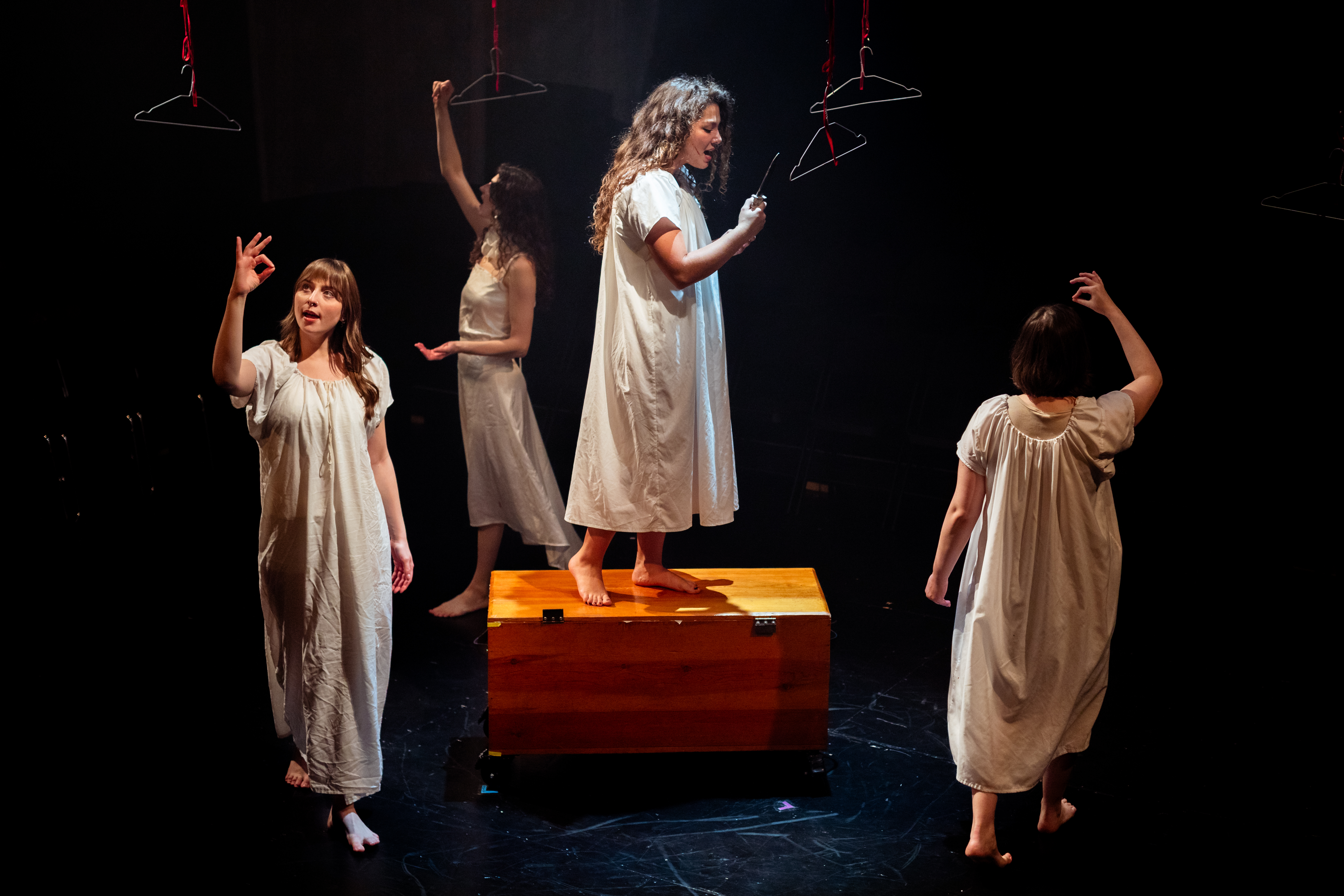
The promise of finding a way to the moon goddess, of cutting the strings that hold these women back, becomes another means of tying them to Vera. “Cut your strings with me, sisters, let me be your guide,” she sings, and the invitation carries an increasingly sinister undertone. Emma Woodside’s cat-hating Charlotte is another peculiar and unsettling presence within this gathering of damaged personalities. Vera’s insistence that the women prove their commitment reaches an especially disturbing point when she asks, “Does anyone else have the bravery?” after we watch Maeve hold her hand over a flame until the pain overpowers her need for acceptance. The answer involves self-mutilation in the name of devotion, an appalling demonstration of how readily the desire to belong can be manipulated into an act of self-harm.
What makes Vera’s hold on these women so compelling is that we can see precisely what she is doing while they remain unable, or unwilling, to recognize it. Smith gives her a persuasive mixture of invitation and menace, and the gradual shift in her attention toward her own needs exposes the narcissism beneath the moon mother’s carefully cultivated promises. “She thinks I deserve to have you,” coupled with the demand, “Don’t question the mother moon,” reveals the possessiveness that has been present all along. The supernatural mythology surrounding the town, including its alternate reality known as The Middle, occasionally makes the narrative difficult to follow. I found myself drawn toward the more unsettling human explanation, the possibility that Vera is a deeply manipulative cult leader whose power comes from knowing how to bend lost people toward her own desires. The women are already anxious about being pretty enough, loved enough, or seen at all, and Vera knows how to turn those fears into a dependence that looks like spiritual awakening.
The performers throw themselves into the physical and vocal demands of the material, while Jacqui Sirois‘s direction and Alli Carry‘s choreography give the production much of its distinctive theatrical pulse. The musical score, with Jesse Richer serving as music director, is full of emotion and carries with it a well-paced energy for much of the evening, although a few of the songs near the end interrupt the momentum just as the story is gathering force. Jack Mosney’s Will, the manager at the horror DVD store where Delaney works and where the grieving and damaged Esther (Lily Logue) repeatedly rents disturbing slasher films, is a particularly difficult character to bring to life in a meaningful kind of way. He is selfish, mean-spirited, and frequently misogynistic, especially toward the damaged young women who come into his orbit.
The writing leaves us with little reason to invest in his romantic declarations, and his song of love, “I Know Who You Are,” carries an uncomfortable irony as he seems to have little curiosity about Delaney and what she is going through. His soliloquy at the end of this tale fails to register with the emotional weight it needs, while “It Doesn’t Matter” feels entirely consistent with the unpleasantness we have already witnessed. The final developments involving Will leave some uncomfortable questions about his intelligence and about what the audience is expected to feel about his fate and the final outcome. Mosney gives the character his full commitment, but the writing leaves him with very little emotional ground on which to stand, even with the two songs he has to sing in the show’s final moments.
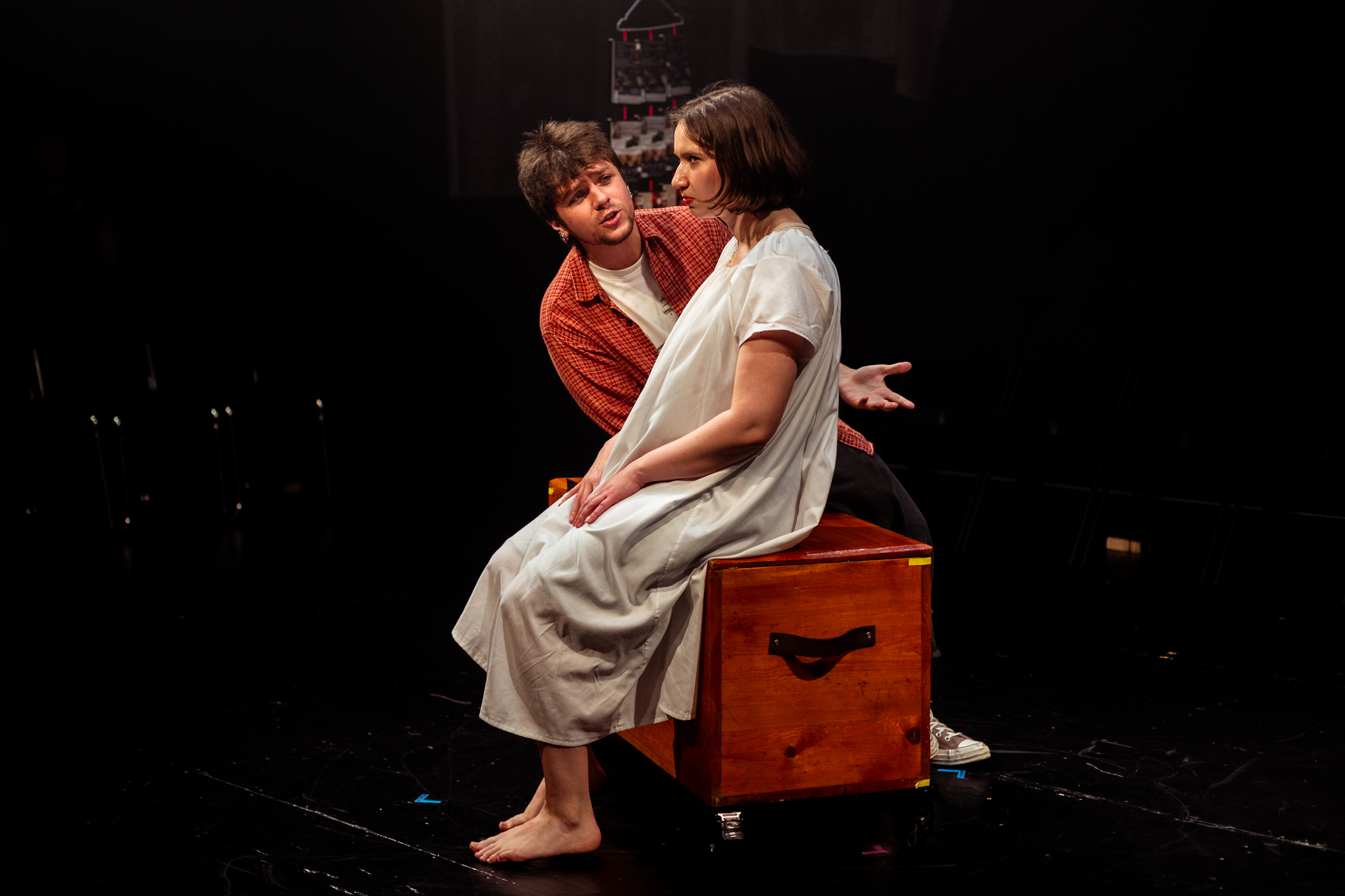
The visuals of When You Close Your Eyes have plenty of imaginative ambition. Taylor Mann’s set, costume, and prop design, Evelyn Rensing’s lighting, and Kai Korven’s sound establish a formidable atmosphere, with the lighting and choreography particularly effective at sustaining the production’s strange, ritualistic mood. Yet the white gowns, the movement of the set pieces, the repeated handling of DVD cases, and the elaborate business surrounding the trunk and the mother’s dress all contribute to an increasingly crowded stage picture. Some of these images carry genuine theatrical promise, yet their repeated appearances and sometimes awkward transitions interrupt the flow of the storytelling. There are a few especially telling moments when an actor reaches to remove or replace one of the nightgowns hanging just beyond comfortable reach. I found myself anxiously watching the physical struggle to stretch upwards and recognizing it as an accidental metaphor for the production’s own ambitions, reaching toward a larger symbolic meaning when the emotional truth is already well within its grasp. The design has a strong visual identity, but a simpler approach to the props and set-piece transitions would have given the strongest images room to breathe.
The promise of release that runs through both works carries a particularly personal sting for me. In “The Liberation“, Ricki offers Rita all-natural mushrooms as a way of freeing her from the suffering she carries, presenting the experience as an act of communal healing and transformation. That scene took me back to a long-ago encounter with a ‘friend’ who tried to slip GHB into my system because he believed it would release me from my ‘tightness’ and allow me to join his own supposedly loving community of party boys. Thankfully, his intentions were revealed, and I walked away from him and from his invitation. The language of liberation and belonging can be dangerously persuasive when someone believes they have identified the loneliness or hurt that another person is struggling to manage. The line from the film, “It’s all a con,” carries a particular sting in that context. What makes both stories so unsettling is the way these women are approached through their need to be heard, understood, and accepted. Their pain becomes an opening for someone else to exercise power, and the language of healing disguises the taking away of their autonomy.
There is a great deal to admire in Pepper’s Ghost Productions’ When You Close Your Eyes, which has grown from its sold-out 2024 workshop into an ambitious and captivating piece of sapphic horror theatre. Its combination of theatrical invention, dark comedy, and genuine emotional distress makes for an evening full of surprises, and the performers bring an impressive commitment to its peculiar world. The production occasionally gets caught up in its own elaborate symbolism and loses its way, but its central concern is a potent one. Vera’s victims are women who want to believe that someone has finally recognized their pain and can offer them a way out of it. The terrible price is the gradual surrender of the very selves they are hoping to recover. That is the ache at the heart of this musical, and it is the reason I kept thinking about Rita, Ricki, and the women of Harmonia in “The Liberation” as the gowns hung in their circle and the chanting began. The promise of liberation is a powerful drug when you feel alone. Knowing who is offering it, and what they intend to take in return, is another matter entirely.