A Toronto Theatre Review: Coal Mine Theatre brings Mamet’s sharp-tongued trio of schemers to life in an intimate production powered by three compelling performances.
By Ross
I’ll admit that putting aside David Mamet’s increasingly disconcerting public comments has become something of a challenge. His appearances on Fox News, including his suggestion that teachers are “inclined” to pedophilia, and his public praise of Trump, whom he has called a “hero,” have certainly complicated my relationship with his work. The Kennedy Center Honour that will soon be bestowed upon him adds another uncomfortable footnote to that story. Still, Mamet’s American Buffalo remains a celebrated piece of American theatre, and I was curious to see what Coal Mine Theatre and director Jordan Laffrenier would make of it in this intimate Toronto production. With Ted Dykstra, Shawn Doyle, and Mackenzie Wojcik taking on its three central roles, the ingredients are certainly there. The production delivers the tension, verbal sparring, and combustible energy that make Mamet’s writing so exhilarating to watch to watch, with three distinctive portrayals bringing his characters to full, ferocious life.
First staged in Chicago in 1975, American Buffalo has accumulated an impressive theatrical history, beginning with its Broadway debut in 1977 with Robert Duvall as Teach, Kenneth McMillan as Donny, and John Savage as Bobby. Later productions have attracted an equally remarkable collection of actors, including Al Pacino, William H. Macy, Cedric the Entertainer, Haley Joel Osment, and John Leguizamo. I was fortunate enough to see the third Broadway revival, starring Sam Rockwell, Laurence Fishburne, and a somewhat miscast Darren Criss, although its cluttered set worked against the play more than for it. Yet it’s easy to understand the attraction. Mamet has created three distinctive characters whose ambitions, insecurities, and shifting loyalties offer actors a great deal to dig into, particularly in the role of Teach, whose bluster and self-invention make him a fascinating presence, basically catnip for an actor ready to have some fun.
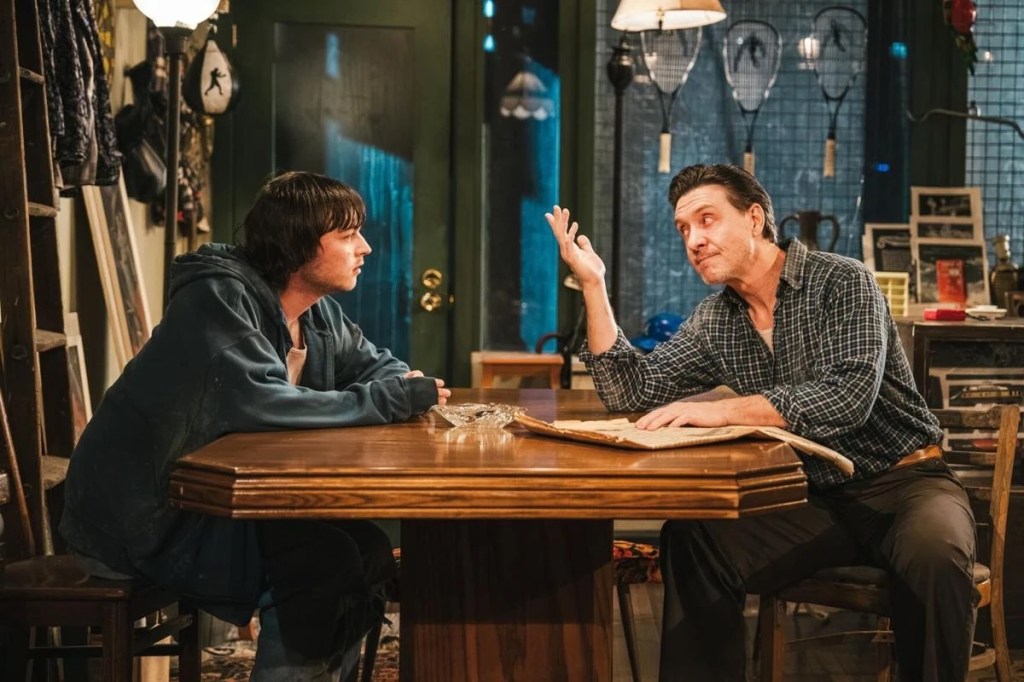
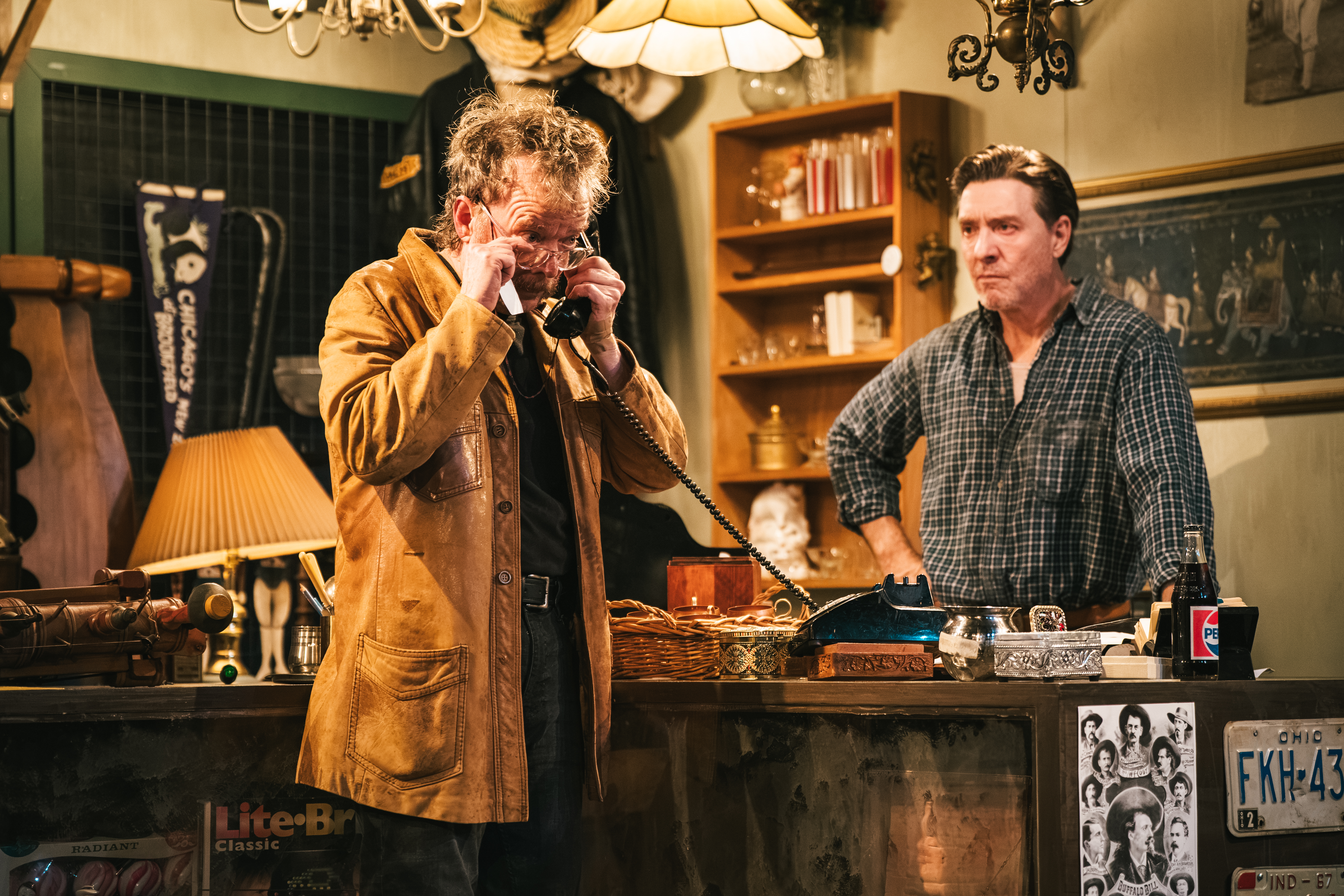
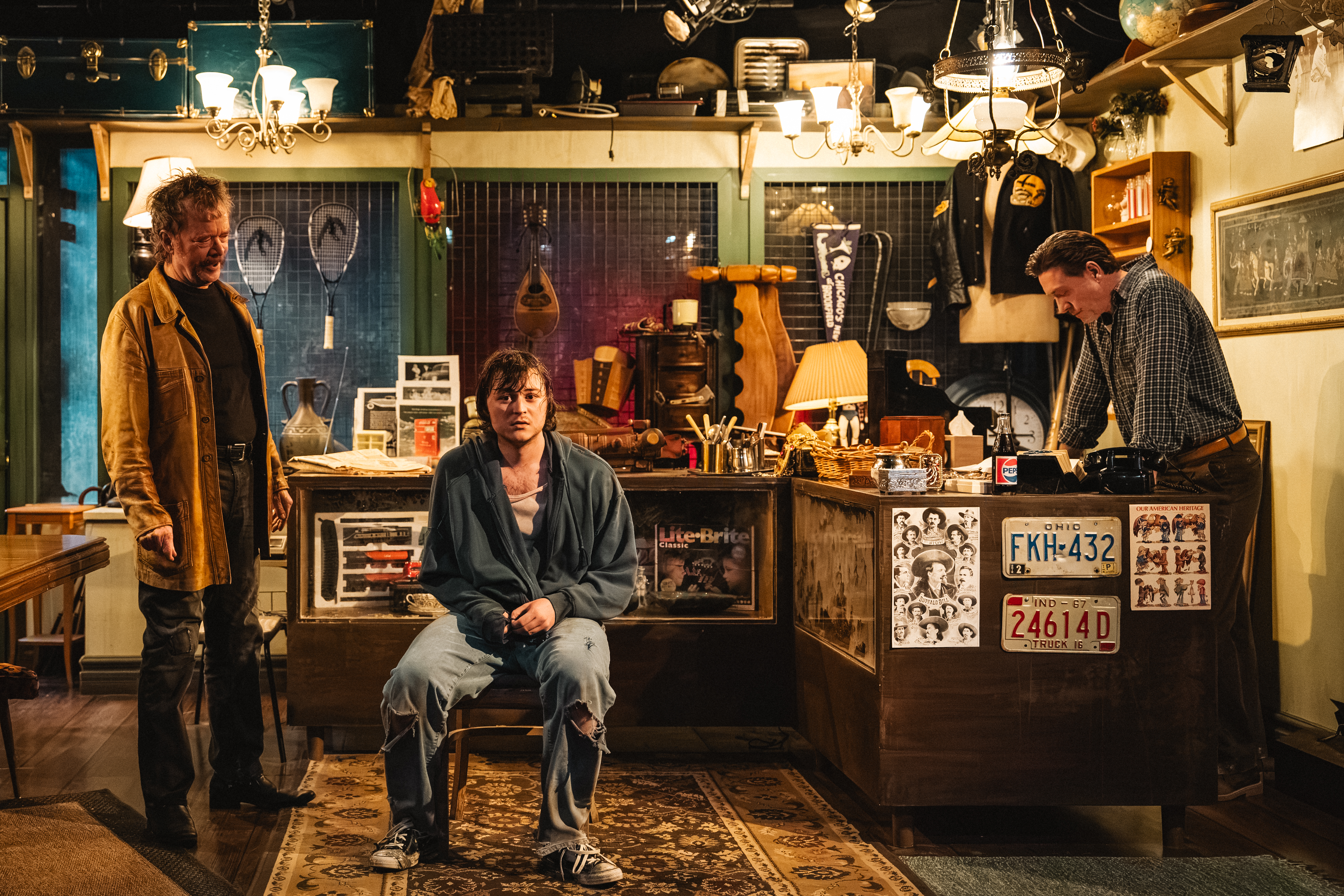
Here, Dykstra takes on Teach, Doyle plays Donny, the owner of the cluttered junk shop, and Wojcik is Bobby, Donny’s young employee. Laffrenier brings the three together in a tightly contained environment where the characters circle one another with the nervous energy of vultures waiting for an opportunity. The set by Ken Mackenzie provides a crowded, convincing home for these uneasy exchanges, with its assortment of objects and accumulated clutter giving the shop a wonderfully chaotic, lived-in quality. Every discarded possession seems to carry a possible story or value, and the space becomes an extension of the characters themselves. Mackenzie’s costume design establishes their individual identities, while Steve Lucas’s lighting and Des’ree Gray’s sound help shape the atmosphere as the negotiations become increasingly fraught. Within this carefully constructed world, Dykstra has a natural command of Teach’s restless, self-deluded confidence, giving the character a wonderfully volatile presence as he talks himself into one increasingly elaborate scheme after another. Doyle brings a grounded quality to Donny, whose apparent authority over the shop and Bobby is constantly tested by his own uncertainty. Wojcik is particularly effective as Bobby, playing his eagerness to please and desperate need for approval with an openness that gives the character an affecting vulnerability.
Doyle and Dykstra bring an engaging volatility to their exchanges, digging into the language with the sharpness and competitive energy the play demands. Their relationship has the feel of an ongoing game of checkers, with each man trying to anticipate the other’s next move while remaining convinced that he has the upper hand. Donny believes he has been cheated after selling a valuable coin to a wealthier neighbour for far less than what he thinks it’s worth, and the proposed theft becomes a way of correcting what he sees as an injustice. Doyle brings an appealing weariness to Donny’s attempts to make sense of the situation, although his growing sense of grievance occasionally needs a sharper edge to propel the scheme forward. Each man is measuring his own worth against what he believes he deserves, and the resulting competition for recognition gives their exchanges an increasingly uncomfortable edge. Wojcik brings a particularly compelling dimension to Bobby, whose desire to be accepted and taken seriously makes him vulnerable to the other two men’s schemes.
The production occasionally loses some of its momentum as the story unfolds. The material has the ingredients for a tightly wound evening, and there are stretches when the two-act structure allows the exchanges to circle familiar territory without generating enough fresh tension. Even so, the performers keep the verbal sparring alive, with Dykstra bringing a jolt of electricity whenever Teach launches into another grand pronouncement. He has “the skill and the talent and the balls” to push his grandiose ideas forward, and his performance gives the production some of its most animated moments. The second act moves toward its destructive conclusion with a sense of inevitability, although the final eruption could use a little more dramatic kindling to give it the full force the story promises. Yet the actors remain fully committed to the escalating disorder, and Mamet’s language continues to crackle with the sharp observations and bruised egos that make his work so compelling.
Mamet has a delicious way of making the smallest of schemes feel like matters of enormous personal consequence, and American Buffalo gives three actors a rich playground of ambition, bravado, and bruised pride. There is a particular pleasure in watching these men talk themselves into believing that one carefully planned theft might somehow put their lives back on track, even as their own insecurities keep getting in the way. Laffrenier and his cast find plenty of humour, friction, and unexpected vulnerability in that uneasy territory, giving the production an engaging theatrical pulse. The pacing may occasionally wander, and the final confrontation could carry a greater charge, but the sharpness of Mamet’s dialogue and the commitment of the performances make this a thoroughly entertaining visit to a very questionable business. Coal Mine Theatre‘s production delivers a lively, sharply performed encounter with three unforgettable schemers, and a junk shop full of wonderfully bad bets.