
The Toronto Theatre Review: Theatre Passe Muraille welcomes back its 20-year-old production, a remarkable solo undertaking that brings Shakespeare’s sprawling tragedy to life through one performer.
By Ross
I have seen Hamlet more times than I can count, and I carry an embarrassingly large collection of performances around in my head whenever I settle into another encounter with Shakespeare’s most famously troubled prince. Watching Raoul Bhaneja take on all seventeen characters in Hamlet (solo), I couldn’t help running through some of my favourite interpretations, particularly those delicious moments from the first season of the Canadian television series ‘Slings and Arrows’. Rachel McAdams as an apprentice actor playing Ophelia, Martha Burns delivering her character’s take on Gertrude, Luke Kirby as the movie star actor Jack Crew playing Hamlet, and Paul Gross as Geoffrey Tennant, the director who seems to love the play more than anyone alive, all came flooding back. Those performances were very much poking around in my head as I settled in to watch Bhaneja attempt something altogether daunting, bringing the entire world of Hamlet to life on his own. Developed in 2002, premiered at Theatre Passe Muraille in 2006, and performed more than 150 times in 25 cities, Bhaneja’s ambitious undertaking is an astonishing demonstration of an actor’s command of Shakespeare’s language, and a theatrical feat that is difficult to imagine forgetting.
Bhaneja enters with the swagger of an actor ready to take on this monumental task, and when he signals the beginning with the command “Lights,” the performance dives forward with the sound of a cold wind howling through the space. That moment of sound and fury is one of the production’s most well-crafted triumphs, creating an immediate chill and a sense of unease in the room that returns with particular effectiveness with the appearance of the Ghost. The guttural sound Bhaneja makes deep in his throat gives the unseen world a presence, allowing the audience’s imagination to conjure something haunting and decidedly unhuman. “Swear!” Bhaneja cries out, pleading with the underworld for resolution, and the challenge of the evening becomes wonderfully clear. He must summon an entire cast through shifts in voice, posture, movement, and expression, moving between characters with astonishing speed while carrying the immense demands of Shakespeare’s text. Under Robert Ross Parker‘s assured direction, the production strips away conventional theatrical decoration, leaving Bhaneja alone against a stark black background, with no set or costume changes to establish the characters. His simple black shirt and jeans become the uniform of a performer whose imagination must supply everything else. The play really is the thing here, and we are asked to give our full attention to the words and to the remarkable transformations Bhaneja creates through voice, posture, and movement.
Bhaneja’s character work is, for the most part, wonderfully inventive. Rosencrantz and Guildenstern are among the more readily identifiable figures, while Polonius, with his rigid physicality and comic shuffle, and his patronizing King Claudius have their own distinct personalities. He finds clever ways to suggest the relationships and power dynamics within the court, giving us a throne where there isn’t one. His gravedigger, complete with an Elvis-like swagger, is a particular delight, showcasing a playful streak that opens up the humour tucked inside Shakespeare’s tragedy. A glance, a shift in posture, or a perfectly timed physical flourish can transform a moment, and I especially enjoyed the death drop and roll that follows Hamlet’s killing of Polonius behind the curtain. It is a beautifully judged bit of theatrical mischief. Bhaneja also brings several familiar lines into sharper focus for me, allowing me to hear their meaning with fresh ears. His delivery is mesmerizing, his concentration unwavering, and there is genuine pleasure in watching an actor who believes so completely in the power of these words.
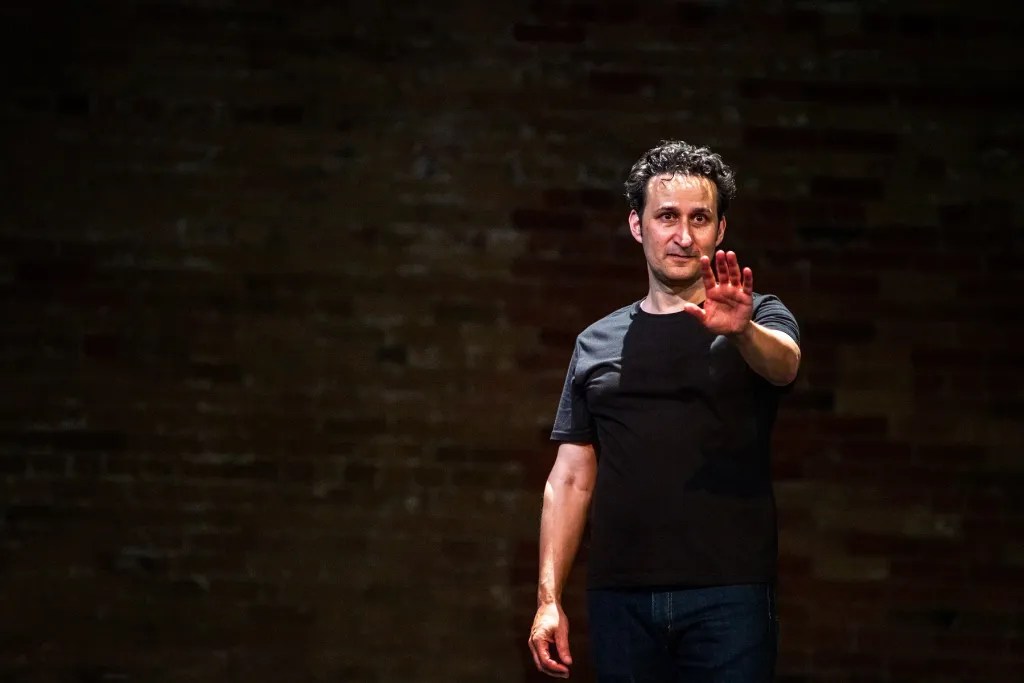
The production’s very premise, however, creates some significant challenges. Bhaneja works impressively to distinguish the seventeen roles, but some of the physical and vocal shifts are not always clear enough, and at times his Hamlet, Horatio, and Claudius begin to blur together. The play-within-a-play, which carries such importance in exposing Claudius’s guilt, becomes particularly difficult to follow as the characters and their shifting relationships are compressed in a way that dims the meaning. Unless you know the story intimately, keeping track of who is speaking and what is happening can become a considerable undertaking. Even with my familiarity with the play, I found my attention wandering, perhaps because knowing the story so well made it easier to float off and pick up the thread again later.
The greater difficulty, though, is emotional. The scene between Hamlet and Gertrude, which has devastated me in other productions, barely caused a ripple of sadness in me here, much like Ophelia’s song of madness. I kept thinking of the extraordinary intensity of those encounters in ‘Slings and Arrows‘ or other productions that I’ve seen over the years, and the emotional history that can gather when those two characters are more fully embodied and realized. Bhaneja gives us the words and the physical action, but the intimacy and anguish of the exchange never quite reach me. The stripped-back aesthetic also presents some visual challenges. Although the half-raised house lights create an appealing sense of shared presence, the stage lighting is sometimes so minimal that important moments lose their impact. The problem is particularly noticeable during the famous “To be, or not to be” soliloquy, which Bhaneja delivers so far back against the wall that his face is frustratingly obscured and literally in the dark. When he reaches that ultimate and most famous line, “The rest is silence,” the words do carry the full weight of the tragedy’s conclusion, but the journey toward that silence had not quite found its way into my soul. I wanted that silence to break my heart.
This is an extraordinary feat of memory, stamina, physical invention, and performance discipline, and Bhaneja deserves every bit of admiration for undertaking it. Yet the production can also feel somewhat alienating when its high-concept approach makes the action difficult to follow or leaves major emotional exchanges without the depth they need. Its return to Theatre Passe Muraille for this 20th-anniversary milestone has an added significance, with proceeds supporting the Andy McKim Endowment Fund for New Works. There is something quite fitting about a production that began in this theatre returning to help support the next generation of artists and the new Canadian work that will take shape there. I left admiring the audacity of the undertaking, and the remarkable discipline and imagination Bhaneja brings to every moment of it, even if some of its emotional depths remained just beyond my reach.