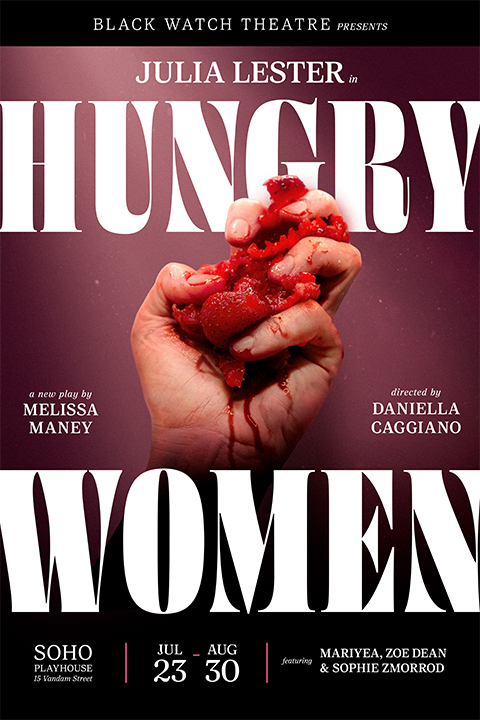
An Off-Broadway review of “Hungry Women” By Melissa Maney, produced by Black Watch Theatre at Soho Playhouse.
By Antonio
Imagine a world without men. We begin in Massachusetts during the 1890s, where a virus has made men extinct, leaving the women to fend for themselves. In the chaos, we meet four women navigating this new reality while finally unpacking their historical trauma caused by the patriarchy. We begin with the “Hungry Women” in Act 1 and travel through the centuries to meet “Curious Women” in 1991 and finally “Scared Women” in 2091. We discover that in the “Great Fires” of 1891, the women burned down the symbols of “history” and recreated a new world for “herstory” to begin.
In Melissa Maney’s provocative play, produced by Black Watch Theatre at NYC’s Soho Playhouse,
she brings many dark, twisted, and exciting ideas to the stage. Cannibalism, being drafted into motherhood, and a world with only same-sex relationships. She allows the four characters in each era to fully explore their conflicting desires and fight to realize their dreams. It turns out a world of only women does not lead to a peaceful society, as they always carry the burden of keeping the society alive by producing babies. As the memory of patriarchy fades through the decades, a natural curiosity evolves in the younger generations, only exacerbated by “The Museum of Male Annihilation,” which contains the history of not only war but also music, paintings, and literature. It seems that, in the attempt to erase “history,” “herstory” is destined to repeat the past rather than learn from it.
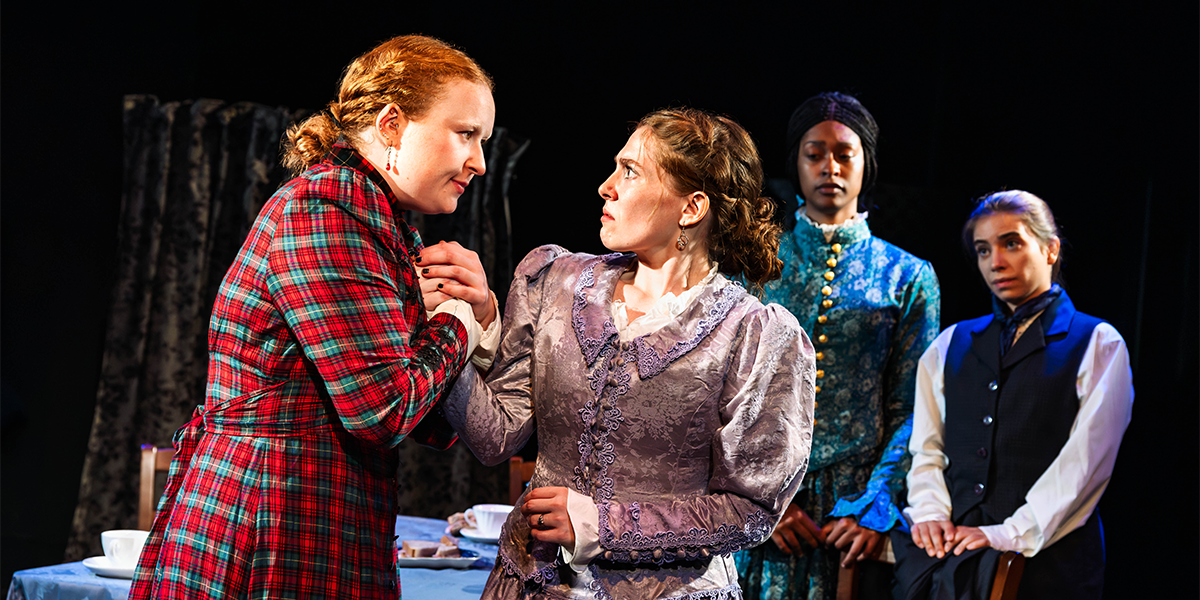
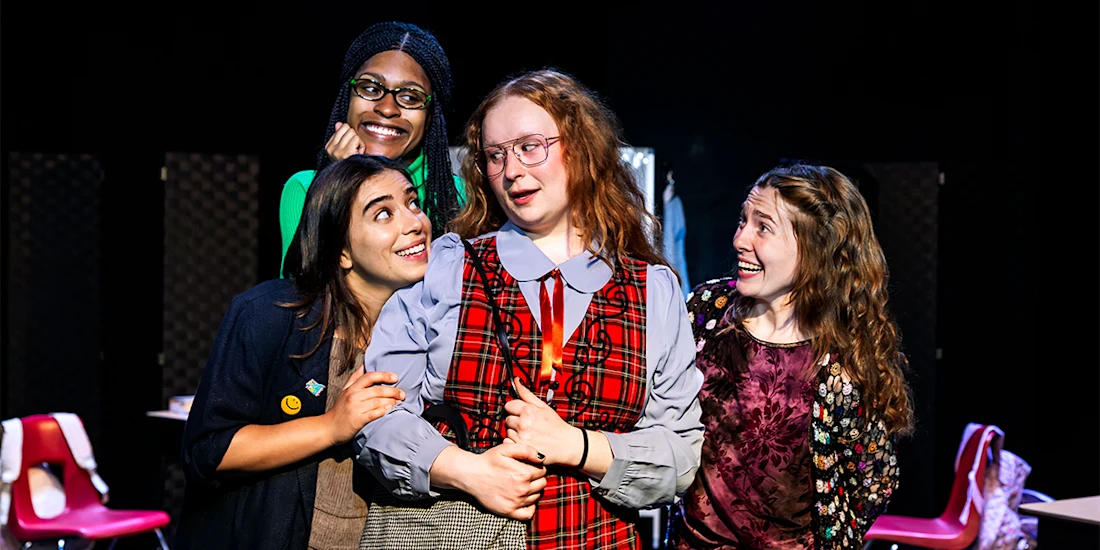
Although I was taken with the play’s ideas, the production felt chaotic at times. I thought Daniella Caggiano’s direction of the three acts was well crafted with a clear focus on growing to a climactic conclusion. Daniella allowed the characters freedom to express themselves, but at times, I felt the characters got stuck, only hitting emotional high notes. I wanted more variety in the emotional response to reflect the ideas faced by each century of women. The actors did an incredible job at keeping the show moving. They were responsible for the scene and costume changes that signified the switch in centuries, performed live in front of the audience. I understand the need to make plays into one act, but I felt it gave no time for the audience or the actors to take a breath and process the moment we just experienced. I think especially after “Curious Women”, the sexual assault séance required more time to resonate so we understood how they became “Scared Women”.
Where the production sometimes struggles to allow “herstory” to breathe, the actors bring a strong sense of commitment to the women they carry across these different centuries. Julia Lester (Ruth, Rebecca & Regina) was masterful at navigating the journey through the centuries and embraced transformation from one century to another. She illuminated the essential quality of each character (and passionately pursued their points of view) while also serving as a strong adversary for the other characters. Sophie Zmorrod (Vic, Valerie, Violet) stood out with her commitment to each character. She really embraced Vic and made cannibalism seem reasonable. Her final transformation as Violet dropped us into a woman who once again was forced into circumstances where she had no other choice but to find a way forward and survive.
Ultimately, after centuries, Mother Earth resets itself, and Violet has given birth to a male child. As the women are introduced to baby Vic and settle in to eat, there is a warning that the birthrate is spiking around the world. They are all babies like Vic. The women have worked tirelessly to save themselves and this planet but are left navigating a world where “History” and “Herstory” must be reimagined. A woman’s work is never done.