
The Frontmezzjunkies Film Review: Christopher Nolan’s epic voyage has the spectacle, but never quite finds the emotional shore
By Ross
As I prepare to see more films than I can possibly imagine over the three weeks of TIFF51, I decided to take myself to Christopher Nolan’s colossal cinematic voyage, “The Odyssey“. I can’t say that I was particularly frothing at the mouth to see this film, but from all the social and critical conversation about it since it arrived, calling the film a masterpiece while also fueling racist commentary that is as disturbing as ever, my curiosity got the better of me. So I went in knowing the noise around it, knowing the scale of the production, the extraordinary cast, the ambition, and the reputation of the filmmaker behind it. I also went in expecting to be somewhat swept away by “The Odyssey” and its spectacle. Instead, I walked out thinking something quite the opposite. I wasn’t bored, per se, but I also wasn’t moved. “It was OK” is all I could muster when a text came in soon after asking me what I thought. That was, probably, the least enthusiastic response I could have imagined having to a Christopher Nolan epic, but it is honestly where I landed. I spent much of its nearly three-hour running time a few steps outside of it, admiring what was in front of me while quietly waiting for this very long voyage to reach its destination.
“The Odyssey” looks absolutely breathtaking, most of the time. Nolan has created a physical, expansive world that gives the film a tangible weight, with an impressive reliance on practical filmmaking and large-scale set pieces. The imagery is enormous, sweeping across landscapes and battlefields with the kind of cinematic confidence you expect from a filmmaker mounting something on this scale. There are sights and scenes that genuinely amaze. Yet the beauty of those images could not solve the larger problem I had with the film, because I kept looking at the spectacle rather than becoming emotionally invested in what was happening inside it. The film felt strangely cold, and that disconnect became increasingly difficult to ignore as the journey continued.
Part of the problem begins with the structuring of it all. Nolan’s fascination with fragmented timelines has become a familiar part of his filmmaking language, and here that approach repeatedly interferes with the natural momentum of the story. I understood where I was within the framing of the narrative, but understanding the mechanics of the timeline is not the same thing as feeling pulled through it. The first hour becomes a succession of temporal threads, flashbacks, and flash-forwards that ask the audience to assemble the story while the emotional stakes struggle to take hold. That was particularly evident during the Trojan War material, where I understood the significance of what I was watching without feeling that in my gut. The narrative keeps moving around and about it all, but the emotional journey never quite gathers the force necessary in its core to carry the enormous weight being placed upon it.
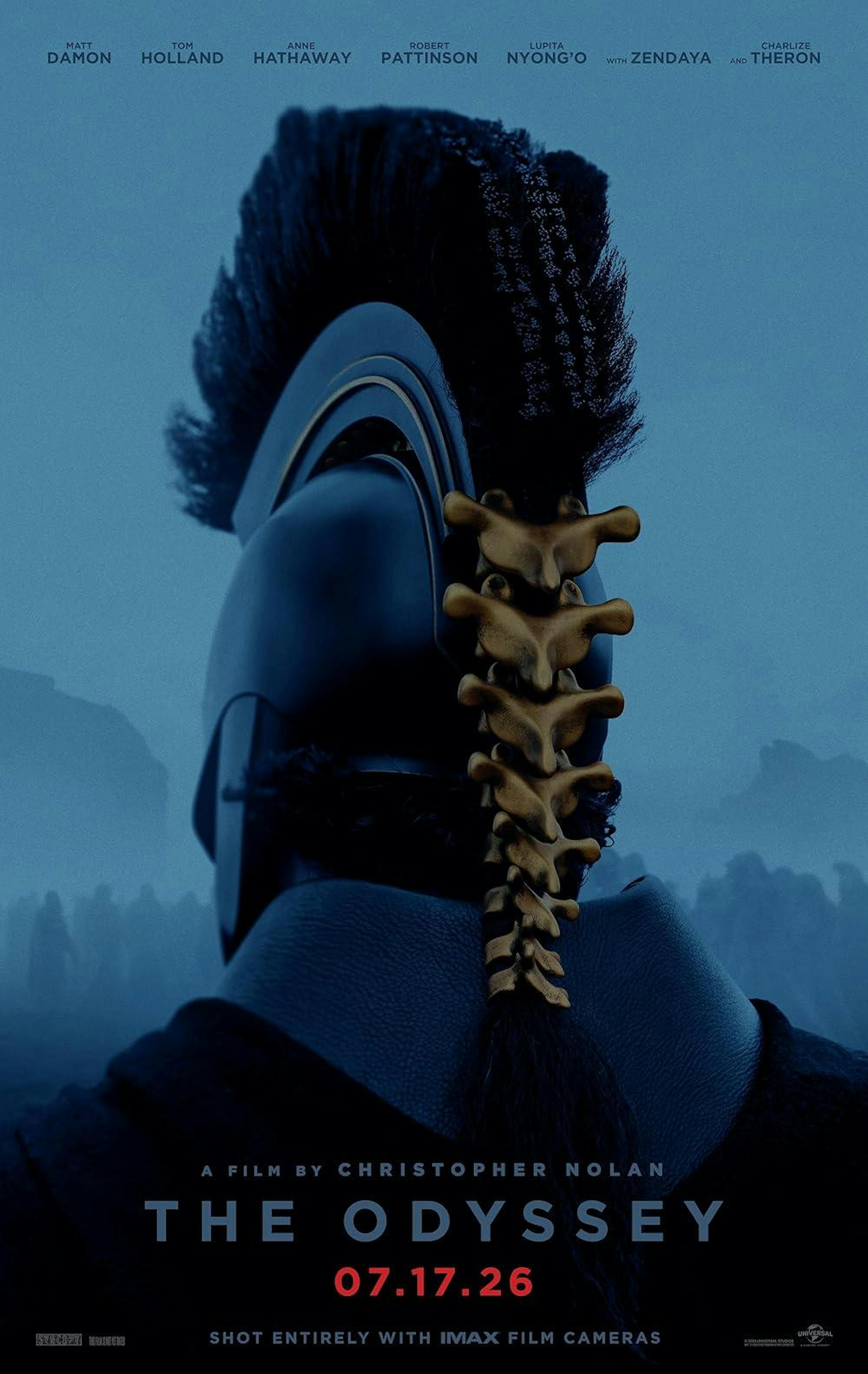
That becomes an even larger issue with Odysseus himself. Matt Damon gives a solid, weary performance, bringing an appropriate sense of determination and exhaustion to a man who has spent years fighting, surviving, and trying to find his way home. Yet the character as written never fully captures the fascinating complexity of the Odysseus at the centre of Homer’s poem. The cunning, adaptability, and multifaceted nature associated with the figure have been pared down into something resembling a brooding movie-star hero with a golden heart and an uncanny ability to fight on even when stabbed with more swords than any other could handle. Damon gives the role what he can, but the script leaves him with remarkably little room to reveal the man beneath the warrior. I kept wanting to know more about this Odysseus, to understand what was happening inside him, yet the film kept sending him onward instead of inward.
The same problem extends throughout the enormous ensemble. Ordinarily, I am quite good at watching a celebrated actor appear on screen and quickly forgetting the celebrity attached to the face. I can usually surrender to the actor’s character and allow them to take me wherever their performance wants to go. “The Odyssey “made that unusually difficult for me, and I had to really ponder the “why” of that dilemma. The problem was not simply that these are famous actors. It was that so many of their characters felt like slivers of people rather than fully developed characters. We are given names, positions, ideas, and fragments of mythology, but not enough personal history or emotional connection to make those roles matter beyond their immediate function in the story. Tom Holland and Anne Hathaway often felt like stars playing ideas rather than people I could fully invest in. Holland finally found some depth and backbone when he realizes who the beggar really is, although even that scene lacked the emotional power I was waiting for from the both of them. Hathaway brings a fierce, grounded quality to Penelope, but I never really felt her turmoil, and her relationship with her son never fully resonated with me. The interpersonal relationships within their home were a muddle that never really was unpacked. There is something especially frustrating about watching actors with this much talent being given so little emotional material with which to work.
And then the parade of recognizable faces continues. I found myself thinking, “Oh, wow, there is Charlize Theron looking magnificent,” or noticing Robert Pattinson, Elliot Page, John Leguizamo, and Jon Bernthal, and thinking about who they are as actors before really taking notice of the parts they were playing. Then we are delivered onto the shores of Samantha Morton, and I found myself wondering what exactly the film expected me to understand about her and her character. Do I google the backstory now, or wait until the credits roll? The notable exceptions for me were Lupita Nyong’o as Helen of Troy, who is gorgeous in the role and carries herself with a presence appropriate to Helen’s mythic stature, and Zendaya as Athena, who has an intriguing presence even if I never felt she fully embodied the character in the way I wanted. It is worth separating that reaction entirely from the ugly racist backlash that accompanied the diverse casting. That criticism has nothing to do with the artistic questions raised by the film. If anything, those characters were among the performances that took me out of the movie the least. My questions about the casting had everything to do with how little the screenplay allowed these performers to develop their characters and give us the information we needed to understand their importance.
Nolan’s decision to ground the mythology in an aggressively realistic world creates another problem. The physicality of the filmmaking is often impressive, but the mythology loses some of the wonder that makes “The Odyssey” such an enduring story. The monsters do not always feel monstrous enough. The supernatural does not always feel supernatural enough. Gods and mythical forces seem to be pushed toward weather patterns, psychological manifestations, and naturalistic explanations, leaving the film with a strangely sterile relationship to its own mythology. When a story contains gods, monsters, curses, prophecies, and impossible journeys, I want to feel some sense of mystery surrounding them. Here, I often felt as though the extraordinary had been placed under a logical spotlight.

That approach also affects the Cyclops material. The famous “Nobody” sequence is such an iconic part of Homer’s story that its absence becomes conspicuous. The trick matters because it shows both sides of Odysseus, the cunning hero who can outwit a monster and the proud man who cannot resist making sure the world knows who defeated it. Removing the wordplay changes how Odysseus’s ego, and therefore his tragic flaw, are presented, shifting the Cyclops encounter toward something darker and more animalistic. Altering pieces of familiar lore can absolutely be part of an adaptation’s artistic strategy, but the changes need to create something compelling in their place. What were Nolan’s choices ultimately building toward, particularly around the connection to the all-powerful Gods that curse his journey? Too often the answer seemed to be another impressive image rather than a deeper emotional or mythological connection.
Even the technical elements occasionally reinforced the same distance. The sets and locations have a tactile, substantial quality that gives the film a physical presence, and much of the visual work is beautiful. Yet some of the interiors struck me as almost theme-park grandiose, like elaborate attractions rather than spaces inhabited by people. Instead of disappearing into the world, I occasionally became conscious of the world Nolan had constructed, sitting there and wondering what country the film studio was in. The sound occasionally created the same distance, with dialogue buried beneath ambient noise and certain exchanges becoming muddy and difficult to absorb. In a film so dependent upon ideas, declarations, and mythological exposition, that matters. Some of the thematic commentary also lands with a clunkiness that feels distinctly modern, pulling me out of the ancient world the film is attempting to create.
And perhaps that is where my frustration with The Odyssey ultimately comes from. I cannot say I disliked watching it. I admired the ambition, the physical scale, the confidence of the imagery, the large starry cast, the impressive set pieces, and the wide landscapes. I wanted to surrender to all of it. I wanted to be carried across the sea with Odysseus, to feel the danger of the voyage, the ache of Penelope waiting at home, the mystery of the gods, the terror of the monsters, and the emotional force of a man trying to find his way back to the people he loves. Instead, I kept finding myself aware of the machinery and not the magic. Damon gives Odysseus a grounded weariness, Hathaway brings strength to Penelope, Nyong’o is striking as Helen, and there are individual performances throughout that deserve attention. But admiration is not the same thing as emotional involvement, and after nearly three hours I was still standing outside the film looking in.
I left the cinema thinking about the journey home that sits at the heart of Homer’s story, and that was the emotional connection I kept searching for throughout Nolan’s film. Odysseus can cross oceans, survive monsters, endure war and confront the gods, but the destination only matters because someone is waiting for him there. For me, “The Odyssey” never made that homecoming feel emotional enough. The voyage is enormous, the images are frequently spectacular, and the mythology is familiar enough to carry centuries of cultural weight, but I spent too much of the journey checking the cinematic equivalent of my watch and waiting for the ship to finally reach shore.

