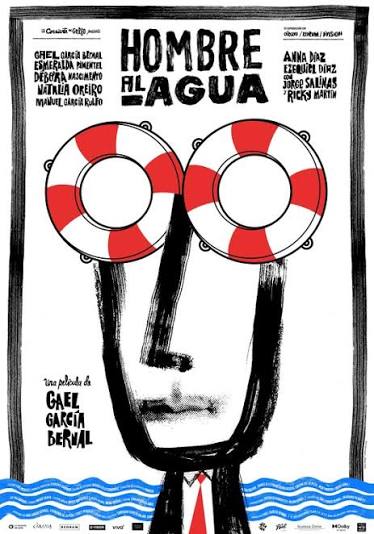
A Frontmezzjunkies TIFF film review: Gael García Bernal’s “Hombre al agua” and Pedro Almodóvar’s “Bitter Christmas“
By Ross
The stories we tell ourselves can become elaborate constructions, full of invention, ambition, and the occasional inconvenient truth. That idea runs through both “Hombre al agua” and “Bitter Christmas,” two Spanish-language films I encountered during my TIFF travels this fall. At TIFF, I was surprisingly swept away by Gael García Bernal’s Mexican comedy of manners, which had its North American premiere at the 2026 Toronto International Film Festival. “Hombre al agua” is a playful, occasionally bewildering excursion into privilege, ambition, and the slippery boundary between reality and fiction written by Garcia Bernal and Mariano Pensotti. It has a few surprises up its sleeve, bobbing through waves of ideas and entanglements, and occasionally threatening to go under. Bernal’s considerable charisma as its star, director and co-writer helps keep the whole enterprise afloat.
García Bernall stars as Camilo, a Cuban lifeguard who rescues wealthy Mexican businessman Abel (Jorge Salinas) from drowning. Out of apparent gratitude, Abel offers Camilo an important position in his manufacturing business and quickly steers him towards marriage to his daughter, Juana (Esmeralda Pimentel). Before long, Camilo finds himself installed in an extravagant Yucatán estate. His new circumstances come with complications, however, including Abel’s pregnant mistress Silvina (Natalia Oreiro) and Juana’s plans to make a film about her own life with Juana portrayed by a Brazilian film star, La Brasileña (Débora Nascimento). As Roby, Ricky Martin steps once again before the cameras, making a small but very entertaining appearance as an actor hired to play Camilo in this increasingly tangled production.

The film opens with beach sounds, music and a spectacular view, creating an atmosphere that brought French cinema to mind. García Bernal plays with the idea of looking at the world through windows and frames, and with the stories people tell themselves about the lives they inhabit. One line, “To escape you have to know where to go,” feels particularly apt for a film filled with dreams, nightmares and flights of fantasy. There is also a wonderfully knowing invitation to hear stories that are “quite exotic,” although the film’s own storytelling soon becomes quite a journey.
García Bernal has plenty of fun with the material, and the film’s willingness to move between farce, satire, thriller and melodrama produces some genuinely entertaining moments, but there are so many loose strings to tie together, like an elaborate piece of macramé, that the film feels more tangled than constructed. The cinematography and sound design give the film an appealing atmosphere and visual energy, and there is an evident appetite for taking big creative risks. Yet the many overlapping plots and films within the film eventually leave the central story bobbing around in rather crowded waters. Some of the supporting characters feel more like comic devices serving the plot than fully developed people, and the tonal shifts never quite settle into a satisfying rhythm. I enjoyed the ambition and the playful touches, even when the film seemed in danger of drowning in its own waves.

“Bitter Christmas” Opens in Canadian Theatres
Pedro Almodóvar’s “Bitter Christmas” (Amarga Navidad) opened in Canadian theatres on November 20, bringing his latest exploration of memory, artistic creation and emotional betrayal to local audiences. I saw the film at TIFF this past fall, and my response centred on a question at the heart of its intricate construction. What happens when an artist turns the private grief and suffering of people who have trusted them into material for their own work?
Moving between 2004 and 2026, the film follows Elsa (Bárbara Lennie), an advertising director struggling with the death of her mother and attempting to shape the troubled lives of her friends into a screenplay, and Raúl (Leonardo Sbaraglia), an established filmmaker whose own creative block leads him to draw heavily on the lives of those closest to him. As the two timelines begin to reflect one another, Almodóvar constructs an absorbing house of mirrors, questioning where experience ends and invention begins, and whether the artist’s desire to create can ever justify the appropriation of someone else’s pain. (click here to read the full review.)

Visually sumptuous, with vivid colours, immaculate interiors, the gorgeous landscapes of Lanzarote and an exceptional, melancholic score by Alberto Iglesias, the film carries the unmistakable signature of its director. Its most electrifying moment arrives when Mónica (Aitana Sánchez-Gijón) confronts Raúl over the liberties he has taken with the lives around him. It is a fierce, deeply personal exchange that brings the film’s questions about artistic freedom and betrayal into sharp focus.
I admired Almodóvar’s willingness to turn his gaze inward, even if I occasionally found the film’s intellectual examination of its subject crowding out the emotional warmth I have come to cherish in his work. Its unresolved final movement left me wishing for the emotional release I had hoped for, but there is a particular pleasure in returning to a festival cinema and discovering where this filmmaker’s restless imagination has taken him. “Bitter Christmas” is a beautiful, layered act of creation, and a deeply uncomfortable examination of what that creation can cost. Perhaps that’s why I find myself circling back to“Hombre al agua,” with its own unruly collection of stories, tangled ambitions and shifting realities, all threatening to spill over the edges of the frame.