
A Frontmezzjunkies TIFF film review: Susanna White and Suzie Miller confront the cost of seeking justice
By Ross
I know something about the particular silence that can follow sexual assault, the way an experience can settle into the body and remain there for decades. Watching Susanna White’s film adaptation of Prima Facie at TIFF, brought the emotional weight of that experience into sharp focus. Miller’s story, based on Suzie Miller‘s internationally acclaimed one-woman play, places us inside a legal system that demands evidence, consistency, and a convincing account from the person who has already endured the violation. It is a difficult subject, and the film understands the particular cruelty of asking someone to prove the truth of an experience that has already taken so much from them.
Cynthia Erivo gives Tessa Ensler a commanding presence from her first appearance at the Old Bailey, where centuries of legal history seem to accompany her confident stride. Her attitude towards the profession is captured in the observation, “It’s not emotional for me. It’s like a game with rules.” In her barrister’s wig and gleaming shoes, she moves through the corridors with the assured gait of a thoroughbred primed for the fight. Tessa is a formidable defence lawyer, someone who knows how to dismantle an argument and exploit every vulnerability in the opposing case. Erivo gives her an edge, a hardness born of confidence, with an emotional guardedness that Tessa rarely allows anyone to penetrate. We see very little of that softer side while she is winning in court or moving through the professional world she has fought so hard to enter. Her performance has a tightly coiled intensity that makes the shift in her circumstances especially devastating. White and cinematographer Mike Eley (“Elsinore“) give the film a striking visual identity, with London’s bridges and waterways almost becoming supporting characters, their grandeur and history providing an expansive setting for Tessa’s ordeal.
The film carefully establishes the world Tessa inhabits, including its class divisions and the particular confidence of a woman who has worked her way up from a working-class background. At first, Julian Brooks (Daniel Ings) appears to offer everything Tessa might want: attraction, intelligence, professional understanding, and the intoxicating feeling of being seen and wanted. There is even a recognition of the cliché of barristers having sex in chambers, but Tessa is swept up in the romance and the apparent safety she finds in him. The film takes its time establishing that attraction, making the eventual assault all the more disturbing. Erivo captures the moment when knowledge and impulse collide, when the woman who has spent her career understanding the law suddenly finds herself unable to control what is happening to her. She conveys the disorientation of those first hours with painful clarity. She showers, tries to make sense of what has happened, and moves through the hours in a state of shock. At one point, she gets into a black cab intending to go to her mother’s home, then changes her mind and asks the driver to take her to the police. The small detail of watching Julian sitting with his coffee and the croissants she bought him the night before gives the scene an unsettling contrast. Life continues around her while hers has been abruptly torn apart.
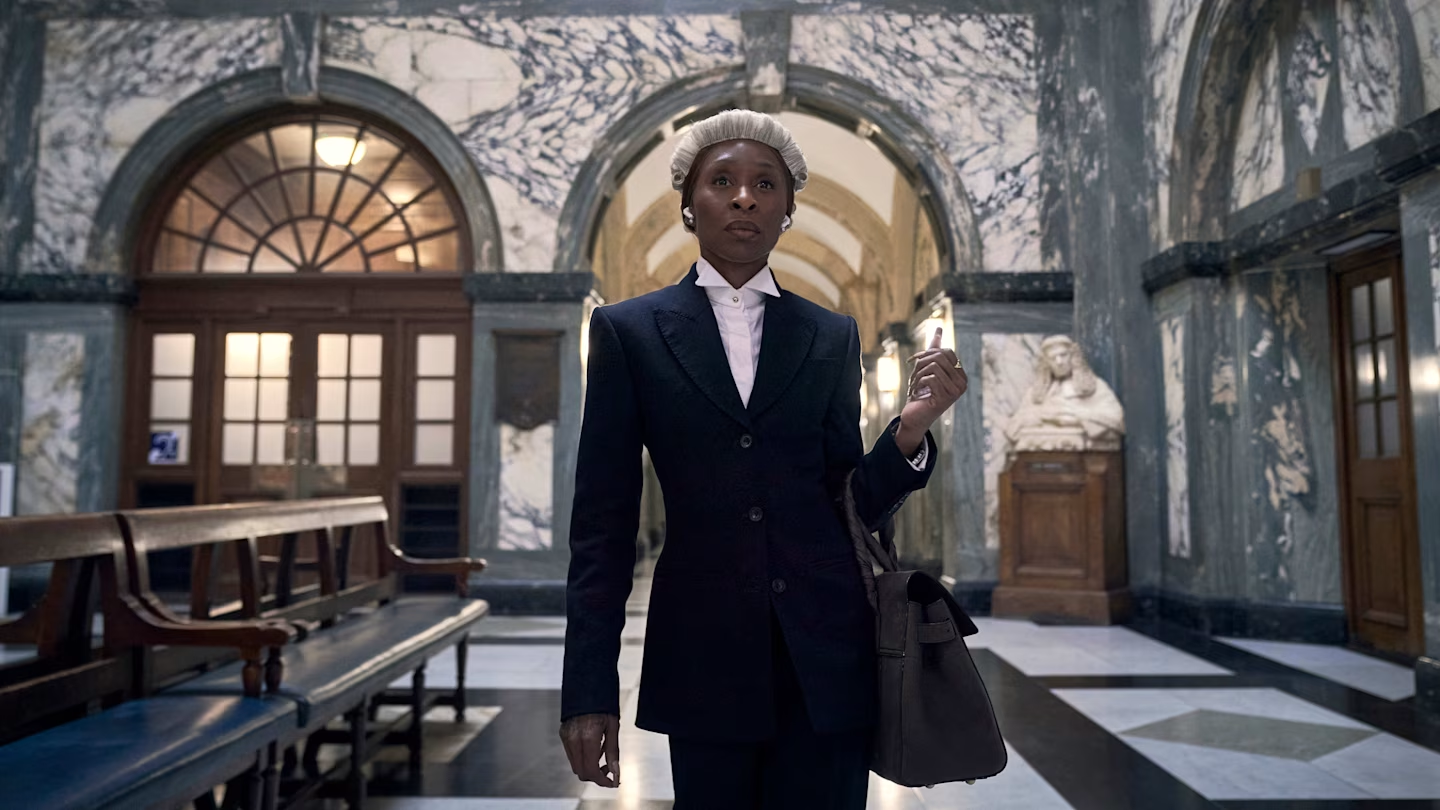
Erivo (“Wicked“) is particularly affecting as Tessa begins to understand the position she now occupies. She knows the tactics of the defence because she has used them herself. She knows what a barrister will ask, where the doubts will be planted, and how the smallest inconsistencies can be turned against the person making the accusation. “He’s a bastard defence barrister, and so am I,” she says, a recognition that carries the full weight of her predicament. She is told she has nothing to be sorry for, but that reassurance cannot quiet the self-blame that has taken hold. The film uses voice-over narration to give us access to her inner turmoil, although some of these passages feel overly familiar and occasionally heavy-handed. The film’s movement into the courtroom brings its own tension, particularly when Tessa faces the familiar strategies of a defence lawyer determined to undermine her account. After 1,107 days have passed since the assault, she must find the strength to return to the place where she once held all the power. The courtroom becomes a different kind of battleground, and Erivo makes us feel the cost of every step she takes towards it.
White and Miller keep the focus firmly on the burden placed upon survivors, exposing a legal system in which the person making the accusation must withstand an extraordinary level of scrutiny. The film’s title, Prima Facie, is a Latin expression meaning “at first sight” or “based on first impression,” an especially apt framework for a story about the assumptions people make when judging an assault and the person who reports it. Consider the figures: one in three women experience sexual assault, yet only one in ten report it, and only one in ten reported cases result in a conviction. Tessa knows these odds, and she pushes forward despite understanding how slim the chance of securing the outcome she wants may be.
The supporting performances, particularly Noma Dumezweni as Tessa’s mother, give the film’s emotional world greater dimension, but it is Erivo who remains its centre. The transition from Miller’s solo stage narrative to a multi-character screen drama fleshes out Tessa’s complex world, and White (“Nanny McPhee Returns“) makes striking use of London’s locations. At times, though, the film settles into the conventions of a legal procedural, and some of the voice-over passages underline feelings that are already powerfully present in Erivo’s face and physical performance. Still, the central confrontation has tremendous force. Tessa understands the law, believes in its principles, and has spent her life mastering its rules. Now she must confront what happens when those rules are applied to her.
I found this a particularly emotional experience, partly because the film reached a place I have carried with me for more than four decades. The body remembers, even when the years have passed, and the incident has been put away in some private corner of the mind. I never reported what happened to me. I dealt with it in my own way, and I recognize the instinct to keep moving, to question yourself, and to wonder whether speaking up will bring any relief. As a gay man, I also recognize how women and gay men can encounter similar dismissals and suspicions when they speak about sexual assault. Prima Facie understands how deeply those responses can wound, and how difficult it can be to ask for justice when the process itself threatens to reopen the injury. Erivo gives Tessa the strength to keep going, even when she knows precisely what awaits her. Her fight belongs to her, but the doubts, scrutiny and demands for proof that confront her extend far beyond that courtroom. The burden of proof may belong to the law, but the burden of living with what happened belongs to the person who endured it.

